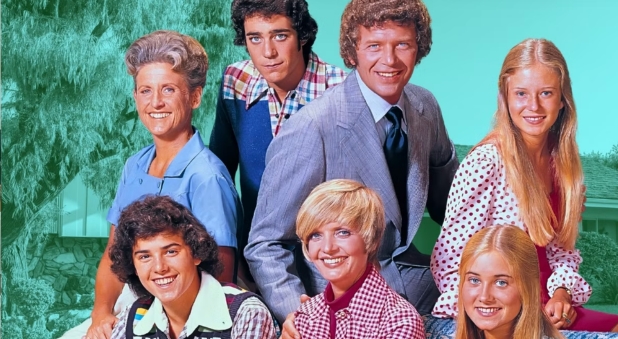
There are many and varied ways in which the Bible values family but is that the same as saying that the Bible promotes family values?
Like many aspects of ordinary life, our modern consumerist culture has a love/hate relationship with the idea of family values and so it is not surprising that Christians feel at home in the parts of society where the concept of family is loved, and alienated from those parts where it is hated.
We resonate with marketing images of happy family gatherings on the deck or in front of the TV or piling into the new family car. As often as not, these narratives focus on the intrepid mum, busy primary school-aged kids, a hapless dad and a pet. So, the nuclear family easily becomes the focus of suburban church life with its “cradle-to-grave” programs offering inspiration for the intrepid and hope for the hapless.
Of course, for a modern family to have the broadest appeal, and the approval of progressive thinking, it should ensure that at least one of the parents has a brown face and/or that both parents have a beard. These blended families are contemporary versions of the nuclear ideal, whereas the more common blended approach must admit to the possibility of tragedy or failure.
Despite the legendary popularity of The Brady Bunch or the Cosbys or even the Simpsons, the “found family” or “family of choice” trope has also grown in popularity in Hollywood and on streamed TV.
In this scenario a group of characters find themselves bonded by shared experience and/or mutual understanding. Especially if the characters were orphans, these arrangements may often bring a sense of belonging, personal worth or acceptance that was either lost or unrequited in the family of origin.
Instead, and often through some kind of trial by fire, the band of companions forge deep bonds of loyalty and affection that make up for what had otherwise been absent. Losing parents is by no means the only grounds, though: the family of choice trope is increasingly employed in stories for those disappointed or disaffected with their family of origin.
Ironically, the chosen family can be every bit as exclusive as the families of origin from which they feel disenfranchised or from which they have chosen to walk away. Thus, adoptive and blended families are not usually included in the family of choice because their relationships exist regardless of whether the members have strong feelings about each other.
In the family of choice, it matters little whether blood is thicker than water because depth of feeling and the freedom to be whomever you choose are the unquestionable values.
Again, not surprisingly, these scenarios, or even a watered-down version of them, might linger on the edge of inner-city congregations but, overall, they simply make conservative Christians want to circle the wagons to protect the homestead.
What God values about family
When we consider what God values about family from the pages of the New Testament, we find comfort for the disturbed and some disturbances for the comfortable.
We start with the fact that the very idea of family flows out of God’s way of relating to his creation or, as Paul describes it, “I kneel before the Father, from whom every family in heaven and on earth derives its name” (Eph 3:14-15). God is the origin of any and every creaturely group that we might recognise as family but, as in all things, most of those groups will experience his love as blessing – even if at times it also will mean wrath.
The most basic value of the family unit is the marriage and from the very beginning, as the Lord Jesus confirmed (Matt 19:4-6), this involves one man and one woman, for life. The original two were intended by God our Father to enshrine the family of origin as fundamental to the pattern of humankind, filling and subduing the earth as the two grow together as one flesh – united but not uniform (Gen 1:26-28 & 2:15-25).
Tragically, in the very next chapter, we also read that the first man and woman envied God’s determination for them and chose self-actualisation rather than dependence on him. Consequently, in their sin, they experienced God’s family values painfully; “Your desire will be for your husband, and he will rule over you” (Gen 3:16).
Ever since, husbands and wives have lived with the constant struggle of whose flesh the “one” will represent most – his or hers.
Nevertheless, God’s love for families cannot be thwarted and so husbands and wives became parents with children – happily or (as Cain and Abel soon revealed) not. Yet, “where sin increased, grace increased all the more” (Rom 5:20).
From within these scenes of the first family failure and tragedy, our Heavenly Father perfected his will by making evil serve his good purposes; “So the Lord God said to the serpent... ‘I will put enmity between you and the woman, and between your offspring and hers; he will crush your head, and you will strike his heel’” (Gen 3:14-15).
What ensues throughout the rest of the Old Testament story is search for a child from the woman as both the natural pattern of family expansion and the hope for sinful humanity – beginning with Abraham and Sarah (Gen 12:1-4). Along the way the everyday family values emerge in parental favouritism or sibling rivalry (e.g. Gen 27).
Frequently, the dramatic accounts of long-awaited and hard-won offspring remind us that children are a gift from God, not a lifestyle option for consenting adults. For that matter, the social significance of family is so much more than nuclear; God’s value of families extends vertically and horizontally as time is measured in generations, and space is the land allotted to tribe and clan – the children of Israel.
The true family
Finally, though, the child arrives as the ultimate gift from God, his one and only Son born to a virgin by the power of God’s Holy Spirit. With his coming, the theological value of family is revealed even as the creaturely pattern of it is relativised (though not erased).
For now, with the coming of the child who will be called Son of the Most High, the long story of the children of Abraham is perfected even as God’s intentions for the children of Israel are revealed.
The institution of God’s family is perfected in the resurrection of Jesus as the eternal and royal Son. In pouring out the Holy Spirit, God constitutes the church as the children of God. All who trust in Christ Jesus as Lord and Saviour receive “adoption to sonship” (Rom 8:15) and as such they receive “the right to become children of God… born not of natural descent, nor of human decision or a husband’s will, but born of God” (John 1:12-13).
Even more, writes Paul, “The Spirit himself testifies with our spirit that we are God’s children” (Rom 8:16) and the blessing of Abraham comes to those who trust the promises of Christ Jesus and receive the Spirit (Gal 3:14). From the perspective of the gospel, whoever has the Spirit of Christ is a child of Abraham – as much if not more so than the children of Israel – and becomes a child of God.
Now that the true Son is seated at the right hand of the Father, the value of family is revealed as husband and wife are joined together to witness to the promise that God our Father makes to the church through Christ (Eph 5:32).
In the power of the Spirit the perennial struggle over whose flesh will make them one can cease. Rather, husbands and wives can be so united in service to the Father that the husband seeks to emulate the self-sacrificial ministry of Christ to and for his wife, even as she gives herself to be made holy and blameless before Him.
However, at the same time we should remember that the ordinary practice of marriage has no future (Matt 22:30), and the unmarried should consider themselves freed for the Father’s service (1 Cor 7) as they are able. Where men and women give up their freedom in the Lord to marry in his service, children remain a gift from God and should be raised accordingly (Eph 6:1-4).
As with any of God’s children, it is the “fruitiness” (Gal 5:22-23) in his service with which freedom is exercised for others that God’s family values, regardless of any other gifts and or talents that the Father distributes.
Over all these things we put on love in the form of generosity and forgiveness to ensure that God’s family turns a house into a home.
The Rev Dr David Höhne is the academic dean at Moore College and lectures in Christian Thought.