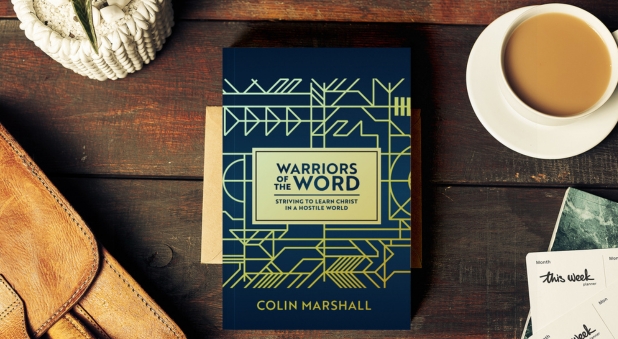
The latest book by Col Marshall (co-author of internationally recognised publication The Trellis and the Vine) is aimed at those reinvigorating a desire to learn and grow as Christians. Southern Cross sat down to discover Warriors of the Word in Col’s own words.
Col: The premise of the book is that I observe in my own life, and in others – particularly through those mid-years of being Christian – a stalling that takes place, some stagnation. Having learned a lot as a younger Christian, possibly, been involved in church life, even led in various ways. But feeling like it's all a bit dry and repetitive and not learning much more.
So I wanted to unpack what causes that stalling and then what to do about it around the theme of learning Christ, seeing that that's the focus of who we are, knowing our Saviour, knowing our Lord. So that's the basic premise of the book.
I think it'll work for anybody, at any stage of their Christian life, but I'm thinking of those I know at church… that have been in that kind of state and just need some encouragement to move forward and keep learning and go to the next level in terms of theological learning.
Keep reading the Bible but learn more deeply from the Scriptures, thinking about the Scriptures.
SC: Who have you seen who did this right? Who are your models?
Col: I think it goes right back to the beginning. The first group I was ever in was led by Jack Griffin, a middle-aged businessman. He was converted at a Billy Graham Crusade, here in Sydney. I was part of a group called the Navigators back in those days. And Jack had this passion to keep learning and to learn more through Scripture memory, through hours of Bible study, through church and sermons and books.
He got us together every Saturday morning from six o'clock or something for a couple of years, just four of us. That was my first taste of really making progress as a Christian. I'd grown up in a Christian home, been baptised, been converted, went forward at the Billy Graham Crusade myself in 1959. But even as a young guy I was a bit stuck in terms of learning… but Jack and that little group just gave me a vision of the joy and benefits of really thinking deeply about the Bible, about Christian faith.
Where else have I seen it? I've seen it over the years as I've trained a lot of Bible study leaders in churches, men and women. When they start leading a group, there's that inbuilt motivation to keep learning because the group's going to ask questions and you really need to be prepared, otherwise it all gets out of control.
I've seen hordes of leaders who've really stepped up and moved forward… in their learning. Most of my learning has been in the context of preparing to do things, preparing training sessions, preparing a talk, whatever. It's one of the best ways of learning. I've seen it in scores of Christians who are taking up leadership.
SC: It's understandable that you get that enthusiasm as a young Christian. You're saying, let's recapture it in midlife.
Col: Yes, that's right. The early learning can become a bit routine, a bit mundane. People then ask what am I learning now? Why am I going to church? What benefit will there be from this sermon? That kind of thing.
We're excited in that first stage of finding out who Christ is and this whole new world of realities being opened up by learning Christ. That can last for many years, but when you get into those mid-years of life with busy-ness, families and all the stresses of life and the cares of this world, it's easy just to float and to forget. Almost like forgetting that first love, that biblical phrase.
SC: In the book you go into some learning styles or genres – some not good, like stalled learning or lonely learning. Can you explain some of those?
Col: Well, the stalling was the broad symptom I'm trying to address… so I wanted to think about, why does that happen? A lot of it is not directly to do with church or anything like that. The anxious learner is stressed about learning anything because they had bad educational experiences; the lonely learner is trying to learn on their own, rather than being in groups and being in church and discussing things with other Christians. The tired learner is just worn out and can't imagine doing a deep Bible study or reading a book because life's just overwhelming.
What's another one? The disillusioned learner feels that life in Christ hasn't really worked out all that happily... Their disillusionment, maybe, with the church around the world and what goes on. Maybe disillusion with other Christians sometimes. So yeah, I asked myself, how do I tap into the reasons for stalling in our learning?
SC: You also talk about the culture war that Christians are involved in, but say that winning that war is not ours to do.
Col: This may be a little bit controversial... I'm not a great expert on the culture wars. I can see that they're all about identity, racial differences, gender, sexuality, justice, injustice, and really huge, important issues. But as I studied this idea of learning Christ, I could see that the fight is to learn Christ and to make him known. That's our fight, not to win the culture wars.
God declared war in Genesis 3 on the serpent by promising that the seed of the woman would strike the serpent down. That's the war we're in now, right to this day, with the world opposed to Christ, with the principalities and powers – the language of Ephesians – being opposed to Christ, trying to destroy Christ's church and Christ's people. It's us learning Christ, making Christ known. That's where our fight is.
We are caught up in a cosmic battle, which is much bigger than the culture wars. The culture wars are sort of a skirmish over here to some extent. But the big battle is fighting to know Christ in myself and then to make him known to others, and to preserve the truth of Christ for the world rather than just winning a particular argument in the culture wars.
SC: So, in a nutshell, what's the antidote to that?
Col: The antidote is understanding what our fight is. That the reason we're given the armour in Ephesians 6 is because our fight is to stand firm in Christ and to help others stand firm in Christ and to put on the armour. [We need to] understand that is the battle, which is what we're doing in church all the time when we're together to proclaim Christ, to help others know Christ but also to help us stand firm against the world, the flesh and the devil. Understanding that will be the antidote to getting caught up, which can become an obsession, in winning the culture wars. Both individually and corporately. I think we're in danger of the culture wars having too predominant a place.
SC: You expose a bit of yourself and your faults as you write. There are regular points throughout the book where you give your reflections and confessions. Was that difficult to do?
Col: No, I don't mind. Sometimes I'm quite private, other times I'm happy to let it all hang out. The worst confession is my proposal to [my wife] Jacquie. You've got to read the book to find out just how badly I fumbled my proposal to her.
But anyway, I wanted to be real. I wanted to have a conversation with the readers, not a how-to manual, not certainly how I've got all this under control. So at the end of each chapter there's a section called Confessions, Conundrums and Commitments. It was actually helpful for my Christian life.
SC: You share some wisdom from Jacquie about what her life is like when she is not reading the Bible.
Col: She gave that in a talk… I thought it was great. I think she was channelling me – what her husband's like when I'm not reading the Bible. I can't remember everything she said, but it was mentally just getting depressed and down, getting disheartened.
It's easier to sin when you're not reading the Bible and hearing from God's word. Getting distracted by things that are not as important as Christ and his kingdom. Just getting lazy in working at learning Christ, easily disappointed, low self-esteem, all these kinds of things she mentioned. I thought, “Yep, she's thinking about her husband”.
SC: You talk a little bit about evangelism. A lot of this is about us growing in Christ. But some of it is about evangelism and “identity conversations”. What's an identity conversation?
Col: This came out of one of the themes of the book, which is wrestling with human identity – who we are as human beings – which is going back to the culture wars… But it's a conversation where instead of starting with God as the creator of the world and he made the world and everything in it, we start with you.
If I'm evangelising you, then I find out about you. I ask just obvious, simple, natural questions like, where did you grow up and what education have you had, or what countries have you lived in or where do you work? Just finding out what makes people tick, basically. Start there because people like talking about themselves probably more than talking about God, so that's a reason for doing it.
But also then there's a bridge there, and I haven't quite worked out how to always make the bridge between discussing what you think about your life and who you are, and what Christ is going to say about you. But there is a bridge there. I just wonder if we should start with identity more.
I tried it with a bloke at a club as I was writing the book. We went through those kinds of things. He was a neighbour and a mate. And at the end of it I said, “Okay, you've told me about your religious life and what you believe and what you don't believe; what you think of Christianity and everything else? Who are you?” I sort of looked him in the eye. And he said, “I've got no idea”.
It was a really telling moment. He knew what I was getting at and I've given him a book to read. I don't think he's read it yet, but it actually worked.
Now I wish I was doing that every day with people, which I'm not, but there's something in there. I've thought of writing a little tract called Too Many Ways to Live. I think in certain circles it might work! And that would start off with identity.
SC: You've written a few books now. Correct me if I'm wrong, but this seems the most heartfelt. The Trellis and the Vine was very much about ministry structure and other things, but this is about you. Is that right?
Col: Yes, I think it's more heartfelt. That's an interesting comment you've made. It's because I had particular people in mind. Tony Payne was advising me, because this is one of the first books – not the only one [but] one of the first I've written without Tony. So, I talked with him at the beginning quite a bit and he said, “Just have your audience in mind; have your readership in mind”.
So it was me. I'm writing for myself, writing for Jacquie, and she's part of it all with me, but writing for my children and grandchildren whom I dedicate the book to. So I had them in mind, the next generation.
And that's become more urgent. I'm in my 70s now. It becomes more urgent.
I had in mind some of the Bible study groups I've been in the past few years – the one I was in last year when I was writing was working at all these things with me and they knew what I was doing. They were making progress in their close reading of Scripture and starting to think theologically, having daily Bible reading times and I could see it actually working in guys that have been around church for a while. And it was just pushing them forward.
So there was an urgency then, and that made it more personal in all those kinds of ways.