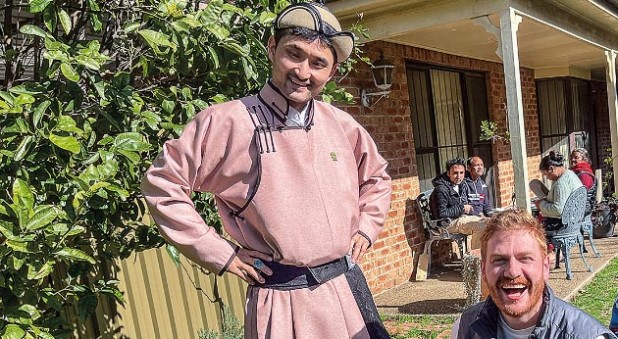
When Lkhagvasuren Bayarsaikhan – Laugva for short – came to Australia from Mongolia to do a Masters’ degree at Bible college, all he knew was that he wanted to do ministry for the rest of his life. He certainly wasn’t expecting to begin the first Australian ministry to his own people and change lives here for Jesus.
“In my first year I was just a student minister [at Canterbury], helping with the ESL ministry,” he recalls. “Then in my home at SMBC, people just began visiting us...
“Mongolia is not a big country; Christian circles are even smaller. I was ordained in Mongolia – my wife and I are both ordained pastors back in Mongolia. People came, they wanted to talk to us, to meet and study the Bible, so that’s what we did.”
Gradually, the number of people visiting his little home on the campus of Sydney Missionary and Bible College swelled to 20, then 30. That’s when he and his wife Otgoo realised the group needed to meet in a larger venue.
With the help of the rector of Canterbury, the Rev Stephen Gardner, he began searching for an existing ministry among Mongolian people. When they found nothing, they realised they would need to be the first: “So that’s how the ministry was born,” Mr Bayarsaikhan says.
He originally linked up with Canterbury parish because Mr Gardner had discovered, to his astonishment, that 15-20 per cent of students at the local public school were from Mongolia. He contacted a lecturer at SMBC – previously a missionary in the country – and was even more amazed to hear that a Mongolian student – Laugva – would be starting the following year.
“It’s crazy,” Mr Gardner says. “We could not have orchestrated that... this is just an absolute God thing.”
Mr Gardner loves Mr Bayarsaikhan’s sense of humour and is struck by the similarity of their theology and missional convictions, even though each was formed and trained on opposite sides of the world, in completely different cultures.
“Laugva is incredibly loved by the church community,” Mr Gardner says. “They have enfolded his family and seen his two youngest kids be born and become part of the church. A lot of his desires for the ministry are ones that are very close to our own heart.”
As the parish’s Mongolian pastor, Mr Bayarsaikhan is only partly joking when he says the role among his community includes “everything”. There is a mid-week Bible study and bilingual ESL Bible study, one-to-one and group fellowship time, prayer triplets and sermon preparation, as well as using his music training to translate a range of hymns and songs into his own language.
He becomes like family to members of the Mongolian community, both inside and outside the church. Some knock on his door at all hours, and he also attends court to translate for cases involving long-entrenched cultural patterns of domestic violence or alcoholism.
“It can be very hard,” he says, “but at the same time, [the ministry is] an amazing opportunity. And St Paul’s, the church, stands with us every moment in everything. It’s beautiful.”
He adds that there are still up to 20 per cent of Mongolian students at the public school.
“That number has never dropped. If you go up Charles Street next to Woolworths there are Mongolian kids playing, running, speaking in their mother tongue. It’s lovely to see them. And if you go to Tasker Park in Canterbury, it’s grandpas and grandmas, just sitting and grabbing fresh air every day.”
Lives changed and new plans
A church service in Mongolian began at Canterbury in 2022, and since the English service began offering live AI translation last year its members often join in there.
More than 300 Mongolian people have been reached over the life of the ministry, about 70 have come to faith and some have been baptised, which thrills Mr Bayarsaikhan.
However, he’s aware that, as a nomadic people, Mongolians move around a great deal – so his ministry plans are taking this into account. Newington Wentworth Point Anglican Churches have expressed interest in supporting the Mongolian ministry now active in Rhodes, while there are also growing Mongolian communities in Wolli Creek and Mascot.
With Canterbury’s blessing, Mr Bayarsaikhan’s work for the next three years will include developing the ministry in these areas, as well as leadership training.
“We’ve been praying about many things, good things, and the Lord is at work,” he says. “Stephen and I just say, ‘Hallelujah, Lord, that is so exciting!’ It’s what we’ve been wanting to happen.
“Please pray for Mongolians who don’t know about Jesus. They don’t know how much the Lord loves them, and I want them to know – that seekers who have never been to church, who have never had a chance to hear about Jesus, can have that offered to them.”