Archbishop Kanishka Raffel has decried the "deeply repugnant" treatment of Aboriginal Elder Uncle Ray Minniecon at an Anzac Day service, as the Diocese prepares to hear the "untold stories” of Indigenous Anglicans.
“Uncle Ray Minniecon is an honoured elder and brother in Christ who has ministered among his people and in the wider community for decades, with compassion, faith and grace in the face of racism, the intergenerational impact of forced removal (the Stolen Generations) and dispossession,” the Archbishop said. “The ugly behaviour of being booed on Anzac Day was a sickening window into the experience of Aboriginal people right up to today.”
“Uncle Ray, who was wearing his service medals at the time, responded with characteristic dignity and courage. I’m grateful for his leadership and example.”
The Archbishop’s comments come as his Indigenous History Project moves from theory to testimony next week as stories are shared in a gathering at historic Glebe.
Indigenous churches and representatives from Nowra, Glebe, Macarthur and Mt Druitt will tell personal stories of their interactions with the diocese across generations.
The gathering will be at Tranby in Glebe, the area of the original 1790 land grant by Governor Arthur Phillip to the Reverend Richard Johnson, the Chaplain of the First Fleet.
Pastor Minniecon, a founder of the Scarred Tree Ministries at St John’s in Glebe, will join the day.
History Heard, not booed
The Archbishop said the actions of Anzac Day revealed a troubling ignorance of Australia’s shared history.
"Such treatment of a respected elder was deeply repugnant, utterly unacceptable and distressing for many,” he said. “Aboriginal blood was shed at Gallipoli too – even though Aboriginal people were officially banned from enlisting for service and did not enjoy the same rights as their white Australian comrades-in-arms at the time.”
The chair of the History Project’s enabling group, Dr Darren Mitchell, is a member of the Anzac Day Dawn Service Trust and was also at the ceremony.
Dr Mitchell noted the deep irony of the protest, pointing out that the site of the Dawn Service was a place where Indigenous people gathered to share stories long before it became a war memorial.
“It's the place where the dawn service originated. Ray spoke about how Indigenous people used that space by the tank stream, to share their own stories, and to share their life. Later, it became a place where the stories of the First World War were told, and shared, and particularly in both cases, our ancestors are remembered in the right way, with honour and respect. It's from that legacy that Ray continues to speak and that enables us to, in a sense, greet the rising sun ready for a new day of peace.”
Dr Mitchell is hopeful the History Project can help.
“What we find is that there's a lot of ignorance and that feeds into the issue we saw at Anzac Day. There’s a lot of ‘don't want to know’ rather than ‘wanting to know’. By beginning in Glebe, we acknowledge our role in the colonial project from day one.”
Speaking, and listening
Archbishop Raffel describes the gathering as “an invitation to our Indigenous brothers and sisters in Christ to share their stories of engagement with our diocese so that we can gain a better understanding of our sometimes painful history and grow as members of our Sydney Anglican fellowship. I think that’s an important part of continuing to build genuine partnership, as peoples reconciled at the cross, to see the gospel reach people 'from every tribe and language' across our diocese.”
The Director of Indigenous Ministry, the Reverend Michael Duckett supported the Archbishop’s words and expressed hope that the project would be a positive step.
“We need to trust and respect one another to go forward together,” Mr Duckett said. “Listening to the stories of Aboriginal people will help us recognize and learn from the past. I’m all for anything that will help us bring the gospel of hope and healing to all people of all tribes and all nations.”
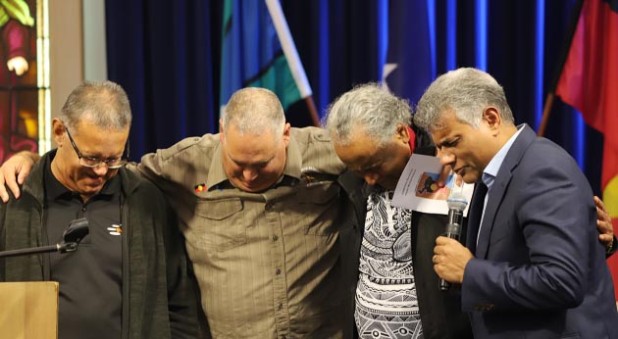
Main photo: Forward together in prayer: Left to right: Indigenous leaders Rick Manton, Michael Duckett, Ray Minniecon with Archbishop Raffel at Mr Duckett’s commissioning last year.