
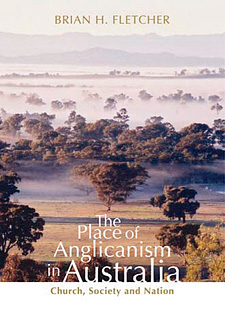
 This history of the Anglican Church of Australia's relation with Australian history in the twentieth century is both welcome and disappointing.
It is welcome because it seeks to address what still is quite a gap in understanding the role of Anglicanism in the history of this country. As Fletcher himself points out in his introduction,
"Alone among the "isms' Anglicanism has largely been overlooked when the formative influences that have shaped national life are under consideration." (p.v)
However the book's title is slightly misleading in that its focus is not so much on Anglicanism in Australia as the role of the Anglican officials, the bishops and other spokespeople, and their contributions to the national debates that have occurred in Australian history. Fletcher's modest verdict is,
It would be too much to claim that the church, when dealing with national affairs, initiated moves the fundamentally altered the course of 20th century Australian history. But it did play an important part in reinforcing and arguing the case for a number of key changes. (p.252)
It is interesting to see the issues which have dominated Anglican concerns over the last century. There is the slow shift of Australia from being a British nation, including immigration issues, the long struggle for the Church of England here to become an independent Australian church, the challenge of dealing with serious diversity among Australian Anglicans, the issues of world war, of communism, of whether this is in some sense a Christian country and of public and economic morality.
Fletcher reveals how some things haven't changed much. Anglican bishops have been complaining about free market capitalism and so-called materialism for the last hundred years or more. I hadn't realised that expressions of dissatisfaction with General Synods as the main way that Anglicans across the nation relate to each other goes back to the nineteenth century when church congresses were held. Not a bad idea for today. And Fetcher shows that Anglican bishops have been complaining about free market capitalism and so-called materialism for the last hundred years or more. Nothing new here. (Does this show a profound insight into human well being, or simply that we have not thought seriously about economics that much, Fletcher doesn't speculate.)
The book is disappointing in that it does not really talk about nor even attempt to draw attention to issues of Anglicanism in Australian society as such. It is astounding, for example, that a book on Anglican in Australia does not even mention evangelism, nor the changing life of the local parish, nor the profound effects of the Billy Graham crusades, nor even the more recent Fresh Expressions movement. We learn almost nothing in The Place of Anglicanism in Australia: Church, Society and Nation about the place of Anglican Christianity in the lives of ordinary people.
Surprisingly towards the end Fletcher allows himself to he gets locked into questions of the moment like women's ordination, homosexual behaviour and, of all things, Gafcon and sadly in passing repeats uncritically recent attacks on the Diocese of Sydney.
I noticed two errors of fact. The statement from GACON last year was the Jerusalem Declaration not the "Gafcon Declaration' (p 257) and the fourth person in the group that in 1957 sought at the last minute to stop the Church constitution being passed was not "the layman SN Shelley' (p.188) but the Rev KN Shelley.


