Who was Martin Luther? This is a question that has proved to be both controversial and enigmatic. Here Mark Thompson navigates us through 500 years of Luther scholarship, before asking a fruitful but rarely asked question"”who did Luther think Martin Luther was?
In most big libraries, books by and about Martin Luther occupy more shelf room than those concerned with any other human being except Jesus of Nazareth.(1) John Todd"”English Scholar
Martin Luther is one of the most studied figures in history, with nearly 1,000 studies published about him each year. From within a few short years of his death to the present day, friend and foe alike have attempted to give a definitive answer to a surprisingly enigmatic question: who was Martin Luther?
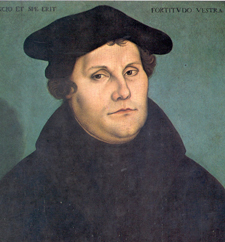
So how are we to understand him? How do we understand a man who, on the one hand, stands almost alone against Church and Empire and yet during his most intense debate (with Johann Eck in Leipzig in 1519) holds a flower in his hand? How do we understand the man Cardinal Cajetan first described as "the monk with strange eyes"?
Luther through the centuries
Despite the vastness of material and opinions on Luther, there are clear patterns that emerge in the literature about him. The most fundamental distinction is, of course, the Catholic and Protestant accounts.
[1] A history of confrontation
Catholic denunciation
In 1549 John Cochlaeus published his Commentary on the Deeds and Writings of Martin Luther. He was a contemporary of Luther who had taken part
in the Diet of Worms. At first trying to bring Luther and Rome together, he later denounced him. In so doing he set the tone for the Catholic approach to Luther up to this century:
Luther is a child of the devil, possessed by the devil, full of falsehood and vainglory. His revolt was caused by monkish envy of the Dominican, Tetzel; he lusts after wine and women, is without conscience, and approves any means to gain his end. He thinks only of himself. He perpetrated the act of nailing up the theses for forty-two gulden"”the sum he required to buy a new cow. He is a liar and a hypocrite, cowardly and quarrelsome. There is no drop of German blood in him ... (2)
A modern example of the same approach is the work of Heinrich Denifle, regarded by some as the most violent attack on Luther since the sixteenth century. His massive tome Luther and Lutheranism, pulished in 1904, has a two-fold argument. Firstly, that Luther was so degenerate that all claim to be God's instrument is ludicrous. His reforming activity was merely a cloak for his moral failings: principally lust and the desire for an easier life. He couldn't cope with monastic obedience so he attacked the Catholic church. Secondly, he said nothing new at all. He was a liar and"”not only that"”a fool who did not understand Medieval theology.
Protestant apologetic
Understandably, Protestant studies of Luther have tended to be apologetic. Luther's own colleague Philip Melanchthon was one of the first to publish a biography of Luther, within months of his leader's death (1546). Melanchthon understood Luther in elevated biblical and eschatological terms. He was God's chosen instrument in the last days to call his people back to himself.
Modern Protestant scholarship is less audacious, but still overwhelmingly positive. W. Koehler (1951) describes Luther as "the great, inexhaustible stimulator". I. D. K. Siggins (1972) understands him to have been "a prodigious man in a prodigious age, a hero in a time of heroes", whilst S. Ozment (1980) claims he was "the most brilliant theologian of his age".
Catholic re-evaluation
In 1939 Joseph Lortz changed the directions in Catholic study of Luther when he published his The Reformation in Germany. He not only plainly admitted that there were problems in the Medieval Catholic Church, he also recognized that Luther can only properly be assessed in terms of his religious and theological concerns. He still had problems with Luther, but was at least prepared to look at what Luther had to say.
Others have built on Lortz's work, especially in the interests of re-unification. Men such as Erwin Iserloh, Stephan Pfurtner, and Otto Pesch have sought to create a more open dialogue between Catholics and Protestants (often by attempting to minimize the differences), but their work has not been explicitly endorsed by the hierarchy of the Roman Catholic Church. In reality there is much less vitriol, but very little fundamental change in Catholic attitudes to Luther's teaching. For instance, a recent joint declaration between the World Lutheran Federation and the Vatican on the Doctrine of Justification essentially argued that the sixteenth century debate over this issue was the result of a misunderstanding and both perspectives were right (which is ultimately a denial of faith alone).
[2] Specific interest reinterpretations of Luther
Over recent centuries, several more specific presentations of Luther have emerged. There is the Enlightenment Luther"”Luther as a forerunner in the struggle for reason and liberty of conscience (eg. Johann Semler; Gotthold Lessing). There is Luther the Romantic (eg. Schleiermacher). Then there is the Marxist Luther, who, according to Engels and Marx was a player in the great socio-economic struggle of European history"”yet unfortunately reluctant to be more than the herald of the early bourgeois revolution. There is the German Nationalist Luther; the Existentialist Luther; Luther the Psychologically Disturbed"”indeed, it is hard to think of a school or theory that does not claim to make some sense of the man and his message.
Amidst all the advances"”and confusion"”of Luther studies, there is one often neglected question that would seem rather fundamental to the issue of Luther's identity: how did Luther see himself?
Luther's self-perception
When this question is asked, four key touchstones emerge, some rather surprising.
[1] A man under attack from the Devil
The picture of the heroic, resolute, self-confident Reformer of the Christian Church is not entirely true. Sure he stood before the Emperor at Worms and refused to recant, but when it was over he had to be helped out of the room after exclaiming, "I have come through, I have come through!" More had been going on at Worms than the observer would have noticed. Luther saw it as a test, a confrontation with the enemy of souls.
Throughout his life Luther felt himself assaulted by the Devil. His life was one long war with the Devil for the sake of God. This warfare was at its most cruel in his many deep periods of despair and dread, when he felt the grinding sense of being utterly lost. These "temptations" of the Devil, which he described with the word Anfechtung, did not subside with time, rather they grew more and more intense. Sometimes they would last for days.
I myself "knew a man' (2 Cor 12:2) who claimed that he had often suffered these punishments, in fact over a very brief period of time. Yet they were so great and so much like hell that no tongue could adequately express them, no pen could describe them, and one who had not himself experienced them could not believe them. And so great were they that, if they had been sustained or had lasted for half an hour, even for one tenth of an hour, he would have perished completely and all of his bones would have been reduced to ashes. At such a time God seems terribly angry, and with him the whole creation. At such a time there is no flight, no comfort, within or without, but all things accuse. At such a time as that the Psalmist mourns, "I am cut off from your sight' ... In this moment (strange to say) the soul cannot believe that it can ever be redeemed other than that the punishment is not yet completely felt ... (3)
The heroic picture of the man who cries "Here I stand, I can do no other. God help me. Amen", leaves us unprepared for the question which laid him low, the question which plagued him all his life, the question he was convinced came from the Devil: "Are you alone wise? ... Look what you have unleashed!" He was tormented with the thought of having led his followers away from the church and into the arms of Satan.
Yet it was this intense and continuing spiritual struggle which Luther himself saw as the melting pot of his theology:
I didn't learn my theology all at once. I had to ponder over it ever more deeply, and my spiritual trials [Anfechtungen] were of help to me in this, for one does not learn anything without practice. (4)
One who has never suffered cannot understand what hope is. (5)
Not understanding, reading, or speculation, but living, nay, rather dying and being damned make a theologian." (6)
At Worms it became clear that the Devil's strategy had blown up in his face. To spite the Devil Luther would enjoy life as a gift from God: be it the flower in his hand at Leipzig or the joy of marriage to his dear "Katie" in 1525.
[2] A man driven
Luther saw himself as a man driven on by God. He had not sought notoriety, he had not sought the monastery, or his teaching post or the confrontation with Rome. Each of these were forced upon him. He was God's captive, who must go where he is driven. While the gospel was imperilled there was no respite, he was swept along from one battle to the next. Looking back each episode was the same:
Here I was driven by God, here I was hurled from the beginning to the outcome. (7)
[3] The abandoned son of the Church
We must blow apart the myth that Luther separated himself from the church of Rome in order to establish a true, pure church of God. Luther had no intention of founding a new church and he had no illusions about purity this side of Jesus' return. His was a call to the old church to be true to itself. At the beginning he had believed the Pope would side with him when he discovered the abuses over which he presided. Indeed, his enemies saw the ultimate implication of his teaching even before he did. Cardinal Cajetan, who interviewed Luther in Augsburg in 1518, had said from the beginning that if these ideas were accepted it would require the building of a new Church.
Luther did not see himself as having abandoned the Church. He saw himself as the most obedient son and servant of the church, risking himself for her welfare. Instead, he had been abandoned, not once but three times: in 1518, when von Staupitz had released him from his monastic vow of obedience; in 1520"”when the Papal bull Exsurge Domine"”condemned him as a heretic; and again at the Edict of Worms in 1521, when he received the Imperial ban.
[4] The herald at the end of the age
Influenced by medieval Christian writers such as Joachim of Fiore and Bernard of Clairvaux, Luther saw the contemporary abuses within the church as an indication that the Last Days had come. This vivid eschatological interpretation of history informs much of Luther's thought. It lent an urgency to his preaching of the Gospel. The time is short, the end is near. God is about to intervene by the return and day of judgement. The only "reform' that could ever be effective is about to fall upon us all. It is now simply a matter of helping as many people as possible to prepare for that imminent judgement ("ark-stuffing"). This gave Luther his explanation for increased opposition: it was the affliction of the Last Days, the last desperate attempts of the Devil to thwart the gospel in the time that is left. It shaped his view of himself. Luther the mere man was not a Reformer. God alone is the Reformer and His Reformation would be the decisive final intervention of the Day of Judgement. And Luther could see the dark clouds of that judgement gathering on the horizon. The end was almost here. Far from being a Reformer, Luther saw himself as a prophet proclaiming the Last Days and calling people to repentance.
[5] No man's master
Luther was appalled at attempts to label the new movement Lutheran or Martinist. This was at first a ploy by those who opposed him to accuse him of being sectarian. In fact he pleaded with people to abandon the usage in 1522:
The first thing I ask is that people should not make use of my name, and should not call themselves Lutherans but Christians. What is Luther? The teaching is not mine. Nor was I crucified for anyone [...] How did I, poor stinking bag of maggots that I am, come to the point where people call the children of Christ by my evil name? [...] It is the papists who rightly bear a partisan name, since they are not satisfied with the teaching and name of Christ, but wish to be the Pope's disciples. As for me, I am no one's master nor do I wish to be. I share with the whole community this common and unique teaching of Christ who alone is our Master. (8)
To Luther, "Luther" was nothing more than an instrument, and what had happened could not be credited to him:
I simply taught, preached, wrote God's Word; otherwise I did nothing. And while I slept, or drank Wittenberg beer with my friends Philip and Amsdorf, the Word so greatly weakened the papacy that no prince or emperor ever inflicted such losses upon it. I did nothing; the Word did everything. (9)
Martin Luther: God's instrument to proclaim his powerful Word as the end of the Age approaches"”with a penchant for flowers.
Endnotes
1. J. M. Todd, Luther: A Life, Crossroad, New York, 1982, p. xvi.
2. Quoted in J. Atkinson, Martin Luther: Prophet to the Church Catholic, Paternoster, Exeter, 1983, p. 9.
3. Martin Luther, "Explanations of the Ninety-Five Theses' (1518), in Luther's Works 31, pp. 129-30.
4. Martin Luther, "Table Talk #352' (1532), in Luther's Works 54, pp. 50-51.
5. Martin Luther, "Table Talk #4777' (1530s), in D. Martin Luthers Werke: Kritische Gesamtausgabe, Tischreden 4, pp. 490-491
6. Martin Luther, "Second Series of Psalms Lectures', in D. Martin Luthers Werke: Kritische Gesamtausgabe, Schriften 5, p. 163.
7. Quoted in H.A. Oberman, Luther: Man between God and the Devil, Yale, New Haven, 1989, p. 211.
8. Martin Luther, "Sincere Admonition to all Christians to Guard against Insurrection and Rebellion' (1522), in Luther's Works 45, pp. 70-71.
9. Martin Luther, "Sermon for Monday after Invocavit 1522', in Luther's Works 51, p. 77.
Further Reading:
J. Kittelson, Luther the Reformer: The Story of the Man and his Career, Augsburg, Minneapolis, 1986.
D. K. McKim, The Cambridge Companion to Martin Luther, Cambridge University Press, Cambridge, 2003.
H. A. Oberman, Luther: Man between God and the Devil, Yale, New Haven, 1989.
Mark Thompson teaches Theology and Church History at Moore Theological College. His D.Phil was on Martin Luther's doctrine of scripture.