"First came love, then came marriage, then came Bella with a baby carriage,' or so the old nursery rhyme goes, rewritten of course for final book in Stephanie Meyer's vampire quartet.
In the first volume, Twilight, the heroine Bella Swan falls in love with the teenage vampire Edward Cullen. The second volume, New Moon, establishes the eternal nature of their love by testing it with absence, competing suitors and the threat of death. Volume three, Eclipse, pits the relationship against all of the terrors vampires and werewolves can muster, finally concluding with Bella and Edward's marriage. Is it any wonder then that Meyer would choose to make the fourth and concluding volume about the product of their love, their child Renesme?
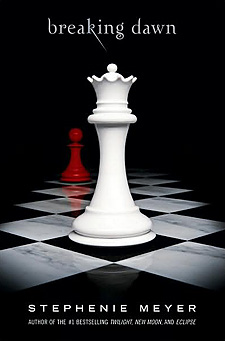 In many respects the romance between mortal girl and immortal vampire unpacked in this series, is a decidedly traditional affair. Bella's biggest emotional growth comes through realizing that she can only really pursue one serious relationship with one man at a time; that to do otherwise is in fact "greedy' and cruel to her intended Edward, and her best-friend-cum-werewolf Jacob Black. Though sexual tension fills the last three volumes, the act itself is held off till after Edward and Bella are married. In this context Bella comes to finally understand the sort of total commitment required for real intimacy, the sort that only marriage can provide. And though the couple are initially unwilling, they also realise that a child is the culmination of that closeness and not an intrusion. As Bella remembers, in wonder:
"Edward was there in her features, and I was there in the colour of her eyes and cheeks. Even [my father] Charlie had a place in her thick curls, though their colour matched Edward's. She must be ours. Impossible, but still true."
The majority of the rest of the book is about the lengths to which Bella and Edward will go to guarantee their daughter's safety. However dramatic, though, it's not the most interesting material for Christians. Far more thoughtful is Bella's long-awaited transformation into a vampire and the quality of the "eternal life' she enters.
Meyer describes eternity, through Bella, as a day that never ends. Vampires do not suffer tiredness and so have no need for sleep. Bella's life is now one long, waking moment with the one she has chosen to give her heart to. Meyer's description of this existence is reminiscent of C.S. Lewis' excellent description of Heavenly life in his novella The Great Divorce. Everything " every creature, every blade of grass, every wisp of wind " is the same, and yet simultaneously far more real. Sights, sounds and smells are imbued with a thousand shades that were always present yet indiscernible until now. In effect, the world has been unveiled in its highest, almost unendurable perfection.
The same might be said of the vampire body. Past death, Bella's body is the same and yet perfected in every way. She looks the same, but every imperfection has been taken away so that there is nothing left but beauty. Her weariness, clumsiness and stunted abilities are things of the past. In short, Bella is finally completely aware of the world around her and perfectly capable of participating in it:
"The brilliant light overhead was still blinding-bright, and yet I could plainly see the glowing strands of the filaments inside the bulb. I could see each colour of the rainbow in the white light, and, at the very edge of the spectrum, an eighth colour I had no name for " I could see the dust motes. They spun like little planets, moving around each other in a celestial dance. The dust was so beautiful that I inhaled in shock" "
The picture Meyer constructs is a useful illustration of the Christian afterlife, and one that might make such a fraught topic far more attractive to a teenage world convinced that Heaven is loads of clouds and harp-playing " or worse still, an eternal church service. Another helpful parallel is Bella's realization that her fear she would lose herself in the transformation to eternity was entirely unfounded.
"I realized that lots of things about me " like truly hating surprises, and not liking gifts in general much more " had not changed one bit. It was a relief and revelation to discover how much of my essential core traits had come with me into this new body."
However this also touches on one of the many points wherein Meyer and Jesus' view of eternity part company. In Meyer's "afterlife' Bella's preserved character includes several traits she might well do without; whereas the Bible promises an undivided heart, presumably one that finally chooses what is right and is capable of holding to its decision. Furthermore, Bella's memories of her past life are muddy and indistinct, even unpalatable because they lack her perfect sight. However I cannot help but think that though the pain will be taken away, our memories of our human life will be pristine. Otherwise from where would our praise for God's many mercies arise? Finally, in Meyer's eternity there remains the prospect of pain and the fear of loss; but in Jesus' Kingdom of Heaven there is an end to suffering and an everlasting confidence in the Father's love.
Much might be said in general against the content of the Twilight series, and in particular against the character and choices modeled by its heroine. But Christians would do well to note the compelling pictures this author is painting for teenagers emerging from the "this is all there is' mindset of the 20th century. There is clearly a hunger for eternity in youth today " and why not?
"I have seen the burden God has laid on men. He has made everything beautiful in its time. He has also set eternity in the hearts of men; yet they cannot fathom what God has done from beginning to end " God does it so that men will revere him." (Ecclesiastes 3:10, 11,14)