A friend once told me that he believed there were three types of businessmen. The first type is completely out for themselves, and leaves you in no doubt about it. The second is happy to partner with you, but if things go bust they want you to know that 'it's not personal' when they cut you loose. The third is as completely mystified by the collapse of the business as you are.
Tom Chandon, the director of Chandon Pictures, is businessman number three.
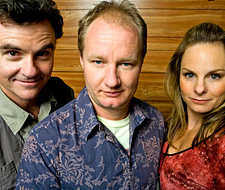 This eight-part series that grew out of a Tropfest short film entry documents the struggles of a film production house that longs for the big time but seems destined to film weddings, parties . anything. Tom Chandon, written and played by comedian Rob Carlton, is a hopeless dreamer who has made one semi-serious production - 'Oh no Bonzo - the clown that killed a child' - and sees every client who comes through the door as the centre of his next big film. His attempts to twist wedding videos, pet tributes and video wills into documentary insights often result in fine examples of cringing comedy. The key to the laughs is, invariably, Chandon's inability to see himself.
Self-delusion has been the backbone of many Australian comedies, most notably Kath & Kim. Tom Chandon has much in common with Australia's favourite foxy-morons, specifically his failure to see how ridiculous, even tragic, he appears in the eyes of others. Chandon's self delusion operates on at least three levels - his unswerving belief that he is a good documentary maker, his faith that his wild ideas will make good films, and his conviction that this self-faith is enough to guarantee him success. After all, people have to recognise talent eventually, don't they? What results is a welcome satire of what is often recommended as 'the power of positive thinking'.
Now there is a certainty irony at laughing at someone who is incapable of seeing their own short-comings, at least from a spiritual perspective. Chandon is a lovable fool, encouraged by even bigger fools. However his position is one we are all in danger of occupying unless we can get some perspective on ourselves. We are, after all, the stars of our own lives, and we seldom hold any convictions stronger than our opinions about ourselves. So it is understandable that humans have a real problem with accepting they might not be all they are cracked up to be, particularly in the eyes of God. Surrounded by supportive egos and insulated with self-confidence, we often cannot get far enough away from ourselves to see what we actually look like - and the view might be so threatening that we are unlikely to want to do so. But as ancient Greek philosophers have been telling us for millennia, the remedy for all problems begins with the simple phrase: 'Know thyself.'
Tom Chandon is given several opportunities to embrace a more realistic view of his life, even as 'inconsequential' white ants threaten to eat his house out from under him. As viewers we are given a similar opportunity. We can look at Tom's delusion and ask ourselves (or maybe honest friends) what delusions we might suffer from. But that, after all, is a very safe comparison. Alternatively we can compare ourselves to people who are truly admirable and see what we lack. This is where Jesus comes in.
The Gospel writer, John, tells us that Jesus knew not only who he was, but who we were:
Now while he was in Jerusalem at the Passover Feast, many people saw the miraculous signs he was doing and believed in his name. But Jesus would not entrust himself to them, for he knew all men. He did not need man’s testimony about man, for he knew what was in a man. (John 2:23-25)
A lot could be gained were we to read about his life and compare his motivations with our own. But Jesus goes further. Knowing exactly who we are, he chooses to die in order to save us. This is the true wonder of the Gospel: not that God understands fools like Tom Chandon, but that He is prepared to send His son to save them.
The second series of Chandon Pictures has been given the go-ahead so it looks like we'll have lots of time to consider Tom's and our foibles yet. However I'm not sure how long this sort of comedy will appeal to me. Am I the only one, or does the idea of laughing at the stupidity of others make you wonder what others may be laughing at when you're not around?