Vampires that resist the urge to drink human blood.
Vampires that are courteous and kind and try to live like humans.
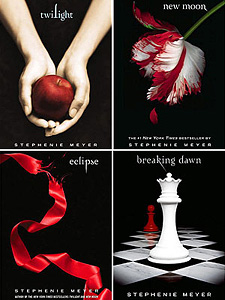
A series of four books about teenage romance in which sex only occurs in the final book, after marriage!
The Twilight series takes the vampire myth and carries it to a different dimension.
Part of that is because the author, Stephanie Meyer is a Mormon, who lets her characters live out her own conservative morals. There are also some religious messages in there. The vampires believe they are created beings, and although immortal, they yearn to be mortal. There are discussions about what happens in the afterlife, with the hope of redemption ultimately. These vampires have chosen the good life (for vampires), of drinking only animal blood, and they recognise evil.
The story involves Bella Swan, who considers herself very plain and awkward, who has moved to the country town of Forks to live with her Dad, the local police officer, to give her Mum space with her new partner. Bella meets the very pale but good looking Edward, who at first seems appalled by her presence, but turns out to be as enamoured with her as she is with him.
He is good looking, courteous, intelligent, extremely coordinated, drives a great car… and is a vampire.
Many would have the same reaction I did when my daughter first mentioned these books to me: "Vampires! No way!" However, she persisted, and I decided to read the books first, on the recommendation of my friend, a minister's wife.
Whereas the vampire myth has traditionally been associated with damned creatures, servants of Satan, only defeated by the power of the Cross… this series offers a different image. These vampires are not that way by choice, and they desire to be human, for human tastes and appetites and loves. This is primarily a story of fighting addiction; of self-denial. Edward resisting the temptation to drink Bella's blood is a constant struggle. Edward’s choice - and the willingness to choose a different way in general - is a major theme in Meyer’s books. “I really think that’s the underlying metaphor of my vampires,” she said in an interview in Time Magazine. “It doesn’t matter where you’re stuck in life or what you think you have to do; you can always choose something else. There’s always a different path.” In fact she admits that being free of addictions is part of the Mormon lifestyle. So it is with Christians, we need to be free of addictions to focus on God and hear his prompting. There is also a strong theme of self-sacrifice, particularly in the second novel, where Edward is prepared to kill himself to protect Bella and her family. In many ways Edward is a Christ-like creature, the lover of Bella's soul.
 These books do have some worrying influences. Although there is a lack of sex scenes, there is plenty of eroticism. Bella is very breathy, and descriptive of her desires. There is also a weird thing about Edward entering her room unnoticed and watching her while she sleeps, before their mutual affection is admitted.
However, the biggest concern for me is the inversion of relationship hierarchies that plays into teenage megalomaniacal desires. Bella is repeatedly making decisions for her father and mother without consulting them; aided and abetted by Edward and his vampire family. It is only in the fourth book that her family find out what is going on. She has removed from them the right to be parents. Okay, she is 17, but the lack of respect and consultation, the constant lying and sneaking around is disturbing because it is unquestioned. In fact Bella also devalues her friendships as well, withdrawing from those relationships, or using them as a cover for access to Edward. Although the all-consuming passion to Edward feels is recognisable as a first love, there is no-one to counsel her about it being obsessive, and the need to show respect, to set some boundaries and find some balance.
However, these are just books, fiction, and there are always faults in characters. I would suggest that those reading the books need to do so in conversation with other Christians. In preparing for this review I visited many Christian blogsites where there were some very strong opinions about whether these books should or should not be read by Christians. Many comments came from people who had not read the books. Many of the positive comments came from mothers who found that these books opened up opportunities for conversations with their teenage children.
Historians believe the vampire myth, found in all cultures, is related to lack of knowledge of the way bodies decompose. It seemed as if blood had been drained from the bodies, and this led to the belief there were creatures that did this. One thing was certain, vampires do arouse in us primal fears. Fear of the undead, fear of that which can drain our life. Freud believed vampires expressed our fear of sexual desire, some believe the story of Count Dracula originally represented political fear of the power of the aristocracy. Typically vampire myths have involved a fear of evil spiritual powers, especially Satan.
The Christian fear of the vampire myth is partly related to the inversion of the significant sacrament of communion. Instead of drinking Christ's blood which brings us eternal life enjoyed in the perfect world to come; supernatural beings drink human blood to bring immortality but enslavement to this fallen world. In an article in Alive Magazine, Michael Frost wonders if the Twilight series is capturing our fear of teenagers. He wonders what there is to fear in them? Perhaps we fear their youth, their worldliness, their connectedness, their apparent sophistication, their great battle with addictions.
The message from the series that we can overcome those things that tempt us is positive, and these books do celebrate abstinence, something very rare in teenage literature. However, they need to be handled with care, like all literature, with the book in one hand, and the Bible in the other.