This is a very timely book and its title alone I am sure will sell copies.
There are two main parts to this book. In the first, the author tries to come up with an economic theory that explains what has been happening. In the second, the author gives a description of the crisis and how it happened.
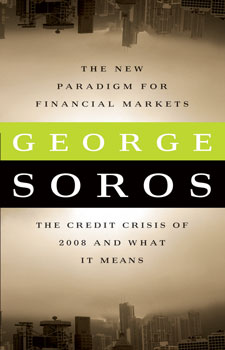 Soros seeks to show how his concept of reflexivity applies in the current financial context. Reflexivity is the idea that market participants do not base their decisions on knowledge alone. Participants' biased perceptions also have ways of influencing the prices in the market.
Soros calls the efforts of individuals to understand their situation the cognitive function and their efforts to try and change their situation the manipulative function. He highlights one major problem with the perfect competition model that drives most economic thought and government policymaking: perfect knowledge is unobtainable. Soros subscribes to Karl Poppers' analysis of the problems with the price mechanism.
The other part of the book is a description of the build up to the current crisis. Soros feels the USA is at the end of the era of credit expansion and the end of the period of the US dollar being the international reserve currency.
He examines the housing bubble and the super bubble that have developed since 2000. The super bubble has occurred because of the excessive reliance on the market mechanism. His outlook for 2008 includes a need for the change in banking. He is optimistic in his outlook for the global economy, which has other drivers such as the increasing wealth of China, India and some Middle Eastern oil-rich countries.
Soros does not believe in ultimate truth yet believes in the need for an open society. He also believes in the concept of radical fallibility, that is, there are many issues about which we are likely to be wrong about because of the complexity of the issues at hand.
Soros' book is part economic theory without quantitative analysis. It is part philosophy based on autobiographical musings. His background as a Hungarian Jew escaping Nazis and living under German and Soviet occupations before making it very rich in the USA means he has much to reflect on and offer in the current financial and political climate.
Read the book if you have an interest in economics and philosophy or if you want a description of what has happened up until March 2008. Whether Soros' theory of reflexivity holds up to scrutiny or whether it is useful really needs further quantitative work. Likewise his optimism for the global economy may or may not be justified depending on how bad the USA crisis continues to get and how much this adversely effects the other countries involved.
As Christians we can pray for others in the USA who will lose their homes as foreclosures destabilise whole communities and have repercussions in employment, health, education and family life.
In Sydney we can also pray for those who are facing mortgage stress and loss of homes. We can encourage people in our churches not to take out mortgages that are too large. That is, more people ought to consider living in other, more affordable, parts of Sydney or Australia.
Likewise we need to counsel those in our churches who are vulnerable to getting involved with "get rich schemes" as the temptation to partake in such quick-fix options increases.
Overall, this crisis can be a time where Christians show our trust in Jesus for the future, as He is our Solid Rock who will not let us down.