It took Louis de Bernieres ten years to research and write his novel, Birds Without Wings. Looking at the book, I feared it might take me ten years to read. Yet the movement of the story via 102 brief vignettes helped me to reach the end on page 640. I was glad I had.
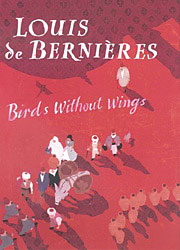 As with his earlier novel, Captain Corelli's Mandolin, de Bernieres throws the detail of village life against the dramatic backdrop of a world war and its attendant catastrophes. Birds Without Wings takes us to a small village in Anatolia, now Turkey, in the turbulent years leading up to WWI and beyond.
In fictional Eskibahçe, Turks live in good-humoured tolerance with Greeks and Armenians; Christians and Muslims are neighbours. Amid trade, intermarriage and acceptance, there is freedom to express impatience with the intricacies of foreign culture. It is a beautiful picture of discord within harmony.
Throughout the story is the biography of Mustafa Kemal who becomes Ataturk, the Father of Modern Turkey. A pragmatist who seeks to democratise his nation, Kemal is an irritating man who consistently lands on his feet. This thread traces the convoluted history of this land of a thousand invasions, and home to a polyglot of half-breed cultures.
A highlight of the story is the experience of a young Turkish conscript fighting at Gallipoli. Told that it is a Holy War (jihad) the Muslim soldiers invite death as their entry into paradise, expecting the attentions of 72 virgins among other glories. The soldier observes the strangest thing about his role is that "you are repeatedly ordered to commit suicide, and you obey. So it was lucky that so many of us wanted to get to paradise."
Candid detail and humour provide wonderful insights into a military campaign that the ANZACs and Australians have claimed as their own. De Bernieres' depiction of the Turkish perspective makes for fascinating reading. It should be mandatory for students of Australian history.
As an old man, still observing the rituals of Islam, the soldier concludes that he is a hypocrite who struggles to believe. "If there is no God, then everything is inexplicable, and that would be very hard for us, but if there is God, then He is not good."
Tragedy within the novel is not limited to wartime. Eskibahçe's wealthy landlord has a young wife who is caught in adultery. Dragged into the marketplace, she is pelted with stones.
At first the crowd is disinterested but Muslims and Christians alike soon warm to their task, protecting the husband's honour and their own reputations. What a contrast with Jesus' reaction to the same situation. "If any one of you is without sin, let him be the first to throw a stone at her." (John 8:7)
Iskander the potter, a loving Muslim husband and father, is important to the unravelling story. His Shakespearean prologue contains all the major themes, especially the tragic fate of a beautiful young Christian girl, Philothei, and the Muslim boy who loved her. They are each casualties of circumstance.
The whole novel points to a ghostly part of history. In 1922-23, following the post-WWI treaties of Sévres and Lausanne, the new Turkish command forced Greek Christians to return to their homeland. The population of Athens doubled overnight and Eskibahçe, already laid bare by years of war and the raids of bandits, is never to be the same.
Looking back, Iskander reflects, "There are those who say we are better off without the Christians who used to live here, but as for me, I miss the old life of my town, and I miss the Christians" Also, since they took their icon of Mary Mother of Jesus with them, there are some who think that we had have less good luck than we did before."
According to de Bernieres there's little difference between the Christians and the Muslims. They were just people, trying to live their lives, looking to their God for help. The novel certainly does not distinguish between truths, and offers no solutions.
In these days of impersonal random killings, I am touched by the words of the Gallipoli soldier, describing the games that developed among the trench warriors of both sides. He says he "got to know his enemies."
"There comes a time when you are satiated with killing" you get lazy about it, and it starts to disgust you. You look into the eyes of the enemy and you don't see an infidel anymore and there is no more hatred."
There is great value in being near those to whom we are different. As wise Iskander says, after the Christians had left, "Without them " we are forgetting how to look at others and see ourselves."
Lea Carswell is a Sydney-based writer who has worked for many corporate clients over the past ten years. She currently oversees Communications at CMS NSW and is involved in recruitment of missionaries.