Science journalist David Quammen, asks in his recent book, Monster of God: The Man-Eating Predator in the Jungles of History and the Mind, why it is more disturbing to have a loved one eaten by a bear than killed in an automobile accident. Quammen resorts to the typical Western creation myth"”Darwinism"”to explain this, along with everything else, arguing the genetic memory "of being a barefoot anthropoid on the East African savanna is relatively recent." And as evidence he points to the Bible, arguing it is obsessed with dangerous animals, beginning with the creation account of Genesis, and that it is less concerned with an abstract notion of "the environment" than with the human relationship to predatory beasts.
Our Fearful Fascination with Wild Things and Other Monsters of God
Wild dogs probably devoured the crucified body of Jesus, a liberal biblical scholar announced several years ago, but it was not his infidelity about the Resurrection that was so rattling. Christianity has been battling such claims since the perjured testimony of the guards at Jesus' tomb. More distressing was the scholar's image of Jesus' body as food for scavenging carnivores.
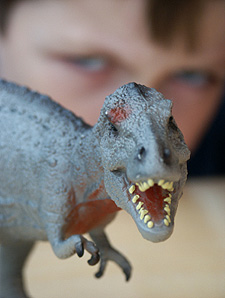 This image is disturbing for a reason, and it points toward a problem for Christianity that is more ancient and more problematic than the naturalistic assumptions found in modern biblical criticism or in the reigning Darwinian scientific paradigm: natural evil. In short, why is it that wild dogs scavenge any bodies anywhere?
For this reason, Christians must understand that apologetic attempts based on general revelation, including natural theologies and the Intelligent Design (ID) movement, cannot rest their arguments on nature alone. Without a biblical understanding of the horrors of nature"”including something as "natural" as animal predation"”a natural theology leaves us with a skewed picture of the Creator and the meaning of life itself.
Being Meat
It is one thing to be dead. It is another thing to be meat.
So argues science journalist David Quammen, as he asks in his recent book, Monster of God: The Man-Eating Predator in the Jungles of History and the Mind, why it is more disturbing to have a loved one eaten by a bear than killed in an automobile accident. Such a gruesome thought has never occurred to most of us, probably because our encounter with predatory animals is limited to watching them safely behind the bars of a zoo, or flickering across the television screen on the Discovery Channel.
And yet we are fascinated nonetheless by these predatory beasts. Television ratings spike dramatically when the networks show some version of "When Animals Attack." And it is not surprising that Peter Jackson's 2005 remake of King Kong took in over half a billion dollars in receipts worldwide. A giant bellowing gorilla rampaging through Manhattan just seems to get our attention.
This is especially true of men, who, like Quammen, often trek after animal predators either in real forests or in their imaginations. Why do little boys (and their brothers, fathers, and grandfathers) so love to think about dangerous animals? Paleontologist Stephen Jay Gould dismissed as "Jungian nonsense" any idea that little boys' love for dinosaurs and other dangerous monsters might be archetypal and universal. Instead, he argued, dinosaur mania is the result of commercialization and consumer hype.
I'm not convinced. It seems that children (and especially boys) from virtually every culture and every era, including children who have never seen television and wouldn't know Barney the Dinosaur from Barney Rubble, have had their hearts set racing at the thought of such creatures. Why?
As Quammen notes, most human beings throughout history have had the experience of listening in the night or surveying the waters for animals that could, quite literally, eat them up. As he puts it in his book: "Among the earliest forms of human self-awareness was the awareness of being meat." He argues that we are fascinated with such beasts, and always have been, because they remind us that human beings are not always at the top of the food chain.
With this in mind, he sets out through the geographic domains of such predators as Indian lions, Australian crocodiles, Russian tigers, and Romanian bears. He likewise traces out the predatory themes in contemporary film, like the ongoing science-fiction series Alien.
Quammen resorts to the typical Western creation myth"”Darwinism"”to explain this, along with everything else. After all, he argues, the genetic memory "of being a barefoot anthropoid on the East African savanna is relatively recent." In his view, this deep evolutionary fear of predatory animals marks out human epic literature, including ancient dragon stories and even the Bible itself.
He points out that the Bible is obsessed with dangerous animals, beginning with the creation account of Genesis, and that it is less concerned with an abstract notion of "the environment" than with the human relationship to specific aspects of the creation order"”such as the predatory beasts. Leviathan, the twisting serpent-dragon of the Old Testament prophets, is, in his words, "the archetype of alpha predators." Moreover, heroic figures in Scripture are often pictured as heroic slayers of dangerous animals. Think of David or Samson.
Exterminating Shepherds
And Quammen, remarkably, gets the shepherd imagery of the Bible more accurately than many Christians, reared as we are on cherubic shepherds in terry-cloth towels in Christmas musicals. The shepherd's primary duty is to protect his flock from predators, and he does this by fighting them off.
That's why the Psalmist is "comforted" by the Good Shepherd's rod and staff. It's not just that they look cool and shepherd-like. They are used to knock the teeth out of big cats and wolves. Quammen also notes, again correctly, that the shepherd-warrior imagery in the Bible is then applied to the Davidic king of the people of God. "The good ruler, like the bold shepherd, devotes himself to exterminating predators whenever and wherever they can be found."
Quammen raises an issue that Christians can answer better than can the Darwinist "just-so stories": why we cannot get predatory animals out of our collective consciousness, even long after we have safely secluded most of them beyond the borders of our suburban sprawl. The contemporary Darwinian creation myth tells us that we are essentially the same as the animals, only further along on the evolutionary chain.
And yet the Genesis account tells us from the beginning what we intuitively already know: There is a deep and ancient divide between humans and the animals. It tells us something else we intuitively already know: Our destiny is intertwined inextricably with these creatures over which we were once given dominion and stewardship.
Christian children's Sunday-school storybooks tend to have pictures of a tranquil Adam and Eve (with strategically placed tree limbs obscuring anything inappropriate for little eyes) gazing at such non-threatening beasts as giraffes and parrots. But Genesis takes care to note that the God of Israel is also forming terrifying creatures, such as the great sea creatures.
Natural Evil
The sanitized view of animals held by modern readers of Genesis tends to obscure this, at least in the Western industrialized world. We may have "phobias" about certain animals (snakes, mice, etc.), but most of us have never known the paralyzing fear of being prey before a predator. The first readers of Genesis would have understood the awe and mystery of the sixth day: that Yahweh has sovereignty over the animals, even the killers.
After all, when the Creator reveals his awesome power to Job, he does not speak to him in terms of abstract philosophy"”of omniscience, omnipotence, aseity, and so forth. God thunders that he was the keeper of the most fearsome animals imaginable, creatures before whom Job and his contemporaries would have seen themselves as, quite literally, meat.
Scripture also uses the predatory animal imagery to explain God's providential nurture of his cosmos. Yes, Jesus teaches that God notes the falling of a single sparrow from the sky, but the Psalmist likewise declares that God drapes the earth with night darkness so that the young lions may seek their prey from their Creator (Psalm 104:20"21).
Quammen's analysis points to a flaw in much of contemporary Christian thinking about creation and the natural order. Perhaps because of our growing distance from animal danger, we have an increasingly anemic theology of predation. Our bookshelves buckle beneath volumes seeking to reconcile the goodness of God with the moral evil of the Holocaust or the serial killer. At the same time, we wrestle with "natural evil" whenever we see children buried beneath a Turkish mudslide, or an elderly Japanese woman weeping before the remains of a home swept away by a monsoon.
We seem to recognize the problem of "natural evil" when it damages homes or property. The tsunami disaster in Asia caused just such reflection among both believers and skeptics. "I do not see how a theistic view of the world cannot be embarrassed, or damaged, by such an event," wrote Leon Wieseltier in the New Republic. "If it is not possible to venerate nature for its goodness, then it is not possible to venerate the alleged author of nature for His goodness."
In contrast, too often there is an uncanny silence when we watch the image of a lioness tearing apart the bloody muscle of an antelope flickering by on the Discovery Channel. Such, we are told, is "natural""”and therefore morally neutral. This has not always been so.
C. S. Lewis, for instance, agonized over how to reconcile animal violence with a good Creator in his classic book, The Problem of Pain. Lewis's conclusion was that predation is not in any sense "natural""”but can only be rooted in the ancient satanic rebellion. The writer Matthew Scully has recently pointed to ancient Christian thought on the evil of predation in order to rebut the poor stewardship of animals by humans who point to the violent natural order as the "natural state" of animal life, a state that can morally be replicated in inhumane factory farms or research laboratories.
Well-Designed Parasites
Yet, if Christians are ever to provide a "counter-story" to the Darwinist creation myth, we must account for a nature that certainly does seem red in tooth and claw, not only in terms of the obvious predators, but also in terms of the (often even more dangerous) microbial parasites.
Christians are effectively countering Darwinism with the obvious truth that the natural order seems to be intelligently and personally designed. I understand this strategy, and fully support it. There is a need for a broad coalition of dissenters against Darwinism among those who don't necessarily agree on the details of cosmic or human origins, and even among those who don't necessarily agree on the identity of the Designer.
And yet Darwinists are already marshalling the theodicy argument that the parasite sapping nutrients from starving children in sub-Saharan Africa seems awfully well designed too. Jim Holt in the New York Times Magazine, for instance, ridiculed Intelligent Design precisely because nature seems "shoddily designed" in everything from male nipples to extinct animal species. Even more "shoddy," the magazine opines, are the pervasive cycles of "wasteful" death in nature"”seen pointedly in the fact that only about one-third of pregnancies result in live births.
"Nature appears to be an avid abortionist, which ought to trouble Christians," Holt concludes. And indeed it should.
We do not want to ignore the issue, and suffer the fate of William Paley and the early natural theologians, who celebrated a romantic notion of the "harmony of nature" as pointing to the goodness of God. Yes, it is easy to say that a formation of geese in the skyline declares the order of the Creator. But what does the bulge of a struggling pig in the mid-section of a python tell us about the Designer of that order? Skeptical philosophers such as atheist William Rowe often point to such "natural" evils as the agonizing death of a fawn to disprove the possibility of a benevolent and sovereign Deity.
It is appropriate and necessary for Christians to apply the "wedge" of general revelation in order to reason with a culture enraptured with Darwinism. But it is only with special revelation that we can answer the question of why nature seems to have gone so terribly awry.
Quammen is right that predators remind us that we're not always at the top of the food chain, but the Scripture tells us that this is not the way it is supposed to be. As a matter of fact, the Bible seems to indicate that the very fact that there is a food chain can be traced back to what went wrong in Eden.
Quammen hypothesizes that there is something especially fearful and fascinating for humans about large, predatory reptiles. We fear them, he argues, because they seem especially sneaky and cunning. In the mid-1980s, NBC sent shivers down the spines of the nation with V, a mini-series that featured peaceful humanoid aliens arriving on earth in spacecraft, and promising medical and technological wisdom.
The tension point of the series came when the "visitors" were revealed to be reptilian creatures hiding behind latex human masks. The television audience was expected to wince in horror when the civilized-looking aliens held guinea pigs over their heads and devoured them whole, with unlocked, expanding snake-like jaws. Quammen would root this reptile phobia in our evolutionary DNA. But what if such a morbid fascination is indeed archetypal?
Not Meant to Be?
Perhaps we are fascinated with all kinds of dangerous creatures"”as evidenced by everything from children's fairy tales to high-budget Hollywood vampire epics"”because intuitively all people know that this is not the way life is meant to be. Even when we cannot verbalize it, we understand that there is an unseen enemy, a cosmic war. In our music, our artwork, and our literature, we all seem to recognize that in some sense, as Lewis put it, this universe is "enemy-occupied territory." And this is true even when we disagree about the identity of the enemy.
Could it be that our fascination with dangerous animals is really just part of a much larger longing for a Christ? After all, as the Genesis narrative tells us, the reason the original creation was not violent is not because of a "natural" animal tranquility. It was not violent because the Creator placed a vice-regent, formed in his image, over all of the animals. He was to rule "over every living thing that moves on the earth" (Gen. 1:28). All things were put "under his feet," as the Psalmist says (Psalm 8:6).
This does not just mean peace between humans and animals, but among the animals themselves. Scripture implies that carnivorous activity does not begin until the shalom of Eden is disrupted. This is the state of nature, as originally and intelligently designed.
But our first ancestor, rather than ruling the beasts, chose to be ruled by the craftiest of the beasts of the field, the serpent"”that is, ruled through his appetite. And so he became "meat" for the alpha predator, who is described across the canon as a Serpent, a twisting sea monster, a wolf in a sheep pen, a dragon who seeks to devour a male baby, and a roaring lion who desires to eat us alive.
And contrary to the "spiritual" pietism of much of contemporary Christian thought, the wreckage from Eden is not just the spiritual bondage of humanity. The Apostle Paul tells the church at Rome that the entire creation groans for liberation from the curse (Rom. 8:21"22).
Luciferian Nature
Darwinist Howard Bloom finds a different storyline from that offered by the Apostle Paul. In his groundbreaking book, The Lucifer Principle: A Scientific Expedition into the Forces of History, published ten years ago, he argued that Lucifer is "the alter ego of Mother Nature."
He builds on the brutality of animal predation to assert that the "evil" seen in the Chinese Cultural Revolution is not uniquely human, and is not distinctively moral or immoral. It "comes from something both sub- and superhuman, something we share with apes, fish, and ants"”a brutality that speaks to us through the animals in our brain." Bloom praises man for dreaming of peace, but concludes that, "to achieve that dream, he will have to overcome what nature has built into him."
But if nature is "satanic," even if only in the most metaphoric of ways, then how can we really hope to cultivate the kind of love for the natural order the neo-Darwinists and their environmentalist allies demand? Does this not present the very kind of essential separation between humanity and the inanimate natural order that the environmentalists blame on Western Christianity?
It is here that the Christian gospel has a uniquely anthropocentric and nature-affirming lens through which to see the cosmos. The reality is not, as the high priests of Darwin tell us, that we are animals aspiring to something great. Instead, we are kings and queens who are becoming animal-like.
After surrendering rule to a reptilian invader, we now turn to animals, birds, and reptiles in our distorted worship (Rom. 1:23). After having the rule over everything that creeps across the ground, we now have to be reminded to look to one the smallest of creeping things"”the ant"”for an example of how to carry out the original human mandate to work the ground (Prov. 6:6). We must be reminded not to act like animals that are governed by their appetites (2 Pet. 2:22). Indeed, we must be reminded by the Apostle Paul not to "bite and devour" one another, as we once did in the old order.
Moreover, every time we sit down to a steak dinner, we are reminded that the tranquility of creation is lost"”and even we are now carnivores. The presence of carnivorous animals"”especially man-eating animals"”is just one more reminder that, as the writer of Hebrews tells us, we do not yet see all things under the feet of humanity (Heb. 2:8).
Indeed, the cosmic scope of human sin is seen in the sacrificial system, present at the earliest moments of human history. Thus, the story of Christian redemption is one of bloody carcasses strewn from an animal sacrifice just east of Eden to a human sacrifice just outside the gates of Jerusalem.
Even Christian worship recognizes the tragedy of predation. In the beginning, God gives to his people abundant vegetation to eat. In the time between the times, we not only are forbidden to insist on a utopian vegetarianism, the apostles teach us (Rom. 14:1"4), but our Lord tells us that we must recognize ourselves as carnivores by eating his flesh and drinking his blood (John 6:53). Christians disagree on what these words mean, whether they are symbolic or involve the "real presence" of Jesus, but would our first ancestors before the Fall even have had a reference point to begin the argument?
Predator & Prey
This means that not only does a theology of animals challenge the reigning secular creation myth, it also challenges the reigning secular eschatology. The vicious dance between predator and prey reminds us that the cosmos is not the story of the inevitability of progress, even though human beings seem to long for such. Our children shout with glee at the idea of fighting Godzilla, but they also cry at the death of Bambi or Old Yeller.
As Christians, we see something on the horizon that Darwinism misses altogether: the ultimate resolution of the predatory cycle. The messianic kingdom long promised by the prophets doesn't simply mean spiritual bliss for humans. It means a cosmic restoration of human rule over the animals, a reversal of the curse of death that holds even them in bondage.
This means, as Isaiah tells us, that in the new creation, "the cow and the bear shall graze; their young shall lie down together; and the lion shall eat straw like the ox," while even a baby can safely "lay over the hold of the cobra" (Is. 11:7"8). This is because in Christ the creation will no longer ask the dreaded question first posed to a couple cowering in the vegetation given to them for food: "Adam, where are you?" (Gen. 3:9). Many of us are uncomfortable with the implications of such passages as Isaiah's vision of the peaceable kingdom.
After all, we cannot imagine a cosmos in which lions do not track down antelope, and mosquitoes do not consume human blood. But is this simply because we cannot imagine a cosmos other than the one to which we've grown accustomed? Could it be that just as the gospel contradicts the "natural" understanding of human death as the end of the life cycle that the gospel likewise contradicts the idea that death is natural at all?
The gospel is not simply a message of "how to get saved" and escape creation. It is a message of the triumph of a divine-human Messiah whose blessings flow, in the words of hymn-writer Isaac Watts, "far as the curse is found."
Indeed, we already see the beginnings of this cosmic triumph. The first advent of the Messiah saw long-waiting Israelites and Eastern Gentile stargazers drawn to the presence of one born in a cattle trough, surrounded by beasts. Mark tells us that as Jesus triumphed over the temptations of the Serpent in the wilderness, "the wild animals were with him" (Mark 1:13).
The Scriptures promise us that Jesus is more than a spiritual guru, more even than a great prophet. He is a dragon-slayer (Rev. 12) and a wolf-killer (John 10:11"12). When he confronts the ultimate expression of human rebellion against God, the opponent is pictured not as a machine, but as a beast rising out of the seas (Rev. 13:1). Moreover, while he is a sacrificial Lamb dying for the sins of the world, he is also an "alpha predator" himself"”a fearsome Lion of the tribe of Judah (Gen. 49:8"12; Rev. 5:5). And he is, as Lewis reminded us, "not a tame lion."
The Other Pole
My little boys were not all that interested in the dust jackets of the other books I was reading at the time I was reading Quammen's book"”with pictures of John Updike, Hank Williams, and Russell Kirk on them.
But they were fascinated with the cover of Monster of God, with a full-color drawing of a fearsome tiger with teeth bared. For them, the appeal is not just tigers"”any animal will do, real or mythical, so long as it is dangerous. They attentively sit through Goodnight Moon, but they squeal, "Let the wild rumpus start" whenever I pull out Maurice Sendak's classic book Where the Wild Things Are.
In our nightly Bible readings, I read every narrative in the canon, but every night they beg me to read "the one about the snake." For some reason, they love to hear about Moses combating the fiery serpents in the wilderness with the bronze serpent on the pole, followed by its fulfillment in, as they call it, "the other pole," the cross of Christ.
My little boys don't simply have a morbid fascination with venomous snakes among the wandering Israelites. In fact, they are never satisfied to end the story there. They wait in silence until we turn to the picture of the crucified Jesus. That's when I tell them how mysteriously this seemingly helpless, executed man confronted the snake of Eden right there on "the other pole""”and finally did what God had promised since the beginning of history.
He crushed its head. He went out beyond the gates of Jerusalem to "where the wild things are""”and he conquered wildness forever. They seem to sleep better hearing that. And so do I.
Perhaps that is because God designed them, and me, to long for the ancient oracle of the Dragon Slayer: and because they were designed to image God in watching out for the predatory Serpent. Perhaps this longing points us toward a story that is not "natural" at all, at least by Darwinian standards: the story of a dead corpse who walked out into the garden of a new creation.
And there wasn't a wild dog in sight.
Russell D. Moore is Dean of the School of Theology and Senior Vice President for Academic Administration at The Southern Baptist Theological Seminary in Louisville, Kentucky. He is the author of The Kingdom of Christ: The New Evangelical Perspective (Crossway). He is a senior editor of Touchstone.