Growing up Catholic, Ray Galea knew little about the world outside the Catholic Church. His only perception of Christianity outside Catholicism was of the church down the road that wasn't Catholic. Little did he know that one day he would become the minister of that church down the road that wasn't Catholic.
In writing Nothing in My Hand I Bring, Ray rings an alarm bell breaking the silence of the night. For years the fears of reigniting bitter sectarian battles from the past have lead to a relative silence from popular Protestant writers about Roman Catholicism until this book.
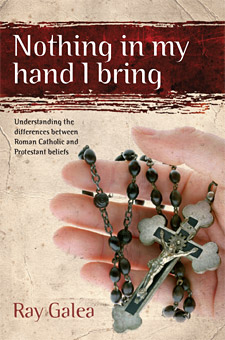 This book is genuinely something new. Rather than trying to stir up old battles, Ray writes from a deeply personal, heart felt and pastoral position about some of the disturbing teachings of the Roman Catholic Church. "My memory is that she cried every day for nearly two years because of my decision [to leave the Catholic Church]. No sin I turned away from was harder than seeing this impact on my mother." He says.
As the Catholic Church in Sydney plans to accommodate half a million visitors for World Youth Day 2008 in a logistical exercise that will be bigger than the 2000 Olympics, Ray's book serves as a reminder that Catholicism is not a friendly bigger Christian brother, but rather an international organization that "at almost every distinctive point undermines the person and work of Christ that I have come to love, and want to honor and serve"
Using his well known colorful and engaging style, Ray makes clear, the sometimes confusing differences between Roman Catholicism and Biblical Christianity. "There is an old line about the difference between religion and Christianity that I have always loved: religion is spelt "do"; Christianity is spelt done. He done it! It may be bad English, but it's great theology" and, "Paul is very explicit about it. He says that justification comes to "one who doesn't work'. We Australians have a word for those who choose not to work; we call them "bludgers'."
After beginning with a warm hearted introduction where Ray talks about his positive experiences of growing up Catholic, he then draws our attention to a number of helpful contrasts; Christ vs. the Mass, the Bible vs. the Pope, Faith vs. Works, and Grace vs. everything else. He concludes with a chapter on Mary in which he shows how Roman Catholic teaching works out in practice.
This short book is for anyone who is confused or uninformed about the differences between Biblical Christianity and Roman Catholicism. It is compassionate and sympathetic, yet lucid and rigorous. It is personally very challenging. It leaves the reader with a good understanding of Roman Catholicism and a conviction of the need to reach out to Roman Catholics with the good news that we sometimes take for granted. The question remains, however, how do we do it?
Extract
School was over for the day, and we were waiting for our buses outside the front gates of St Aidan's Primary School. I asked my friend, Charlie Gauci, "Which direction does your bus go to take you home?"
"My bus goes down this road and then turns right at the church that is not a Catholic church", he said.
I think that was the very first time it dawned on me that there were such things as churches that were not Catholic churches. I was eight years old. Little did I know then that thirty years later I would end up the minister of that church at the end of the road that was not a Catholic church.
My memories growing up as a Roman Catholic were mostly positive. Our parish priest, Father Morreau, was so deeply loved by everyone in the community"”even the Anglicans"”that they named the local reserve after him. As his altar boy for eight years, I remember him patiently answering my questions: "If the Pope died while visiting Australia, would they bury him in Australia or ship his body back to Rome?" And: "Could a boy become a pope?" I clearly had high ambitions.
Even so, as I grew older, it began to dawn on me that being Catholic was more about belonging than believing. For a good number of Roman Catholics, going to mass, which still remains a day of obligation, did not seem to be an obligation at all. They just didn't go. In fact, some seemed quite comfortable to write "Roman Catholic' on the census and yet openly profess that they did not even believe in God.
Looking back, one of the oddest things about my Catholic upbringing was my attitude to Jesus. I may have prayed the "Gloria in Excelsis' with its exalted view of Jesus as the supreme and only Lord, but I had no personal sense of Jesus' complete authority over my life, or his centrality for the Christian life.
Like many young people, my late teens were a time when any relationship with God was going to be on my terms. I somehow managed to get God to agree with pretty much everything I did. He was most compliant, or
so I thought.
While studying Social Work at Sydney University, I got to know Anne, who came from a home that did not believe in God. To my surprise, she started becoming one of those "Jesus freaks'. One day Anne challenged me. "Ray," she said, "Jesus is either Lord of everything, or he is a liar or a lunatic. Who do you think he is? You need to make a decision." She could have said more but she didn't need to. I realized the implications straight away. I could see that if Jesus was not my Lord, then I was in trouble. I also realized that despite my Catholic upbringing and all the teaching and instruction I'd received, I had never seriously examined the claims of Christ for myself.
So I read the Gospels. This was a profound experience. I knew a lot of the stories. But what was completely new and unfamiliar to me was the portrait of Jesus that emerged as I read. There was a ring of truth about him, and about what he said and did. This was Jesus, the Son of God, in all his glory, and I couldn't deny it.
Several weeks later, I was talking with two of my friends, both Catholics, about all the changes I would have to make if I decided to follow Jesus. The choice was pretty stark. I could keep living on my terms for the next sixty years, and be cut off from God forever. Or I could surrender to Jesus as the Lord, make a completely fresh start, and enjoy forgiveness now and acceptance on the Last Day. The penny had dropped, and there and then I told my friends, "I am a Christian". This was the decisive change in my life, but it would not be the only change.
If Jesus was to be my Lord and Saviour, I needed to think through which church to go to. I did not want to assume that just because I was born a Catholic that, by definition, this was the right choice. I knew I could just as easily have been born a Baptist or a Mormon. So I spent the next six months reading and talking to priests and ministers to find out the differences between Catholics and Protestants. How did each of their teachings compare with the teaching of Jesus and the apostles?
To my surprise and hurt, I gradually, reluctantly and painfully discovered that every "distinctive' teaching of Roman Catholicism seemed to undermine the person and work of the Lord Jesus. A time came when I realized that the differences were not superficial, and that I could not with a clear conscience remain a Roman Catholic. I felt I could no longer remain within the Catholic Church and be true to the Lord Jesus.
 This excerpt © 2007 Matthias Media
Reprinted with permission
[url=http://www.matthiasmedia.com.au]http://www.matthiasmedia.com.au[/url]