The sermon delivered at the Sydney Diocese 2006 Ordination Service, Saturday 4th February by the Rev Dr Mark Thompson, Academic Dean Moore Theological College
It is hard to over-estimate the significance of an occasion like this one.
On one level it would be easy for some to dismiss its importance. After all, it is a very formal occasion. Formal responses will be made to the questions asked. An ancient expression of fellowship and recognition, the laying on of hands, takes place here at the front of the building. We will pray in words that are provided for us. What is more, in an important sense the real action takes place elsewhere. We have brought these men and women out of the congregations where they will serve to join this one for the morning, but it is back in those congregations and in the community surrounding those congregations that they will, we pray, have a real impact. It's not so much what happens here but what happens there that is of real significance.
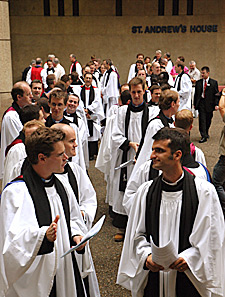 And yet this morning, with 51 men and women standing before us, welcomed and encouraged by us in the mission we share with them, it is a significant occasion. It is a wonderful testimony to the work that God is doing amongst us. For this large group"”larger than any other group of workers that have been commissioned in this cathedral"”this large group is not the product of some astute recruitment campaign; it's not something that we or our leaders have been able to engineer by good strategic planning. Nor is it simply a reflection of the more conservative culture emerging at the beginning of the twenty first century. It is the work of God. God has raised up these men and women to serve his people and to take his message to the world. God has convinced them to turn aside from other things and spend their lives doing this. God has prepared them and gifted them and opened up this opportunity for them to honour him in this way. What we see here this morning is the result of God's work. These men and women are here because God has taken hold of their lives, drawn them to himself, opened their eyes to the world as it really is, and sent them into the fields that are white for the harvest.
We are not admitting these people into some secret society or guild or holy club this morning. No magical power is being dispensed today in this building. They won't leave this building somehow changed. Today these people formally take on the task that they have been training for, some for many years. It is the task of taking God's gospel to the world, and it is, without a doubt, the most important task that anyone can undertake. Because the gospel, the message they bring to their churches, their communities, to the world, is the most important message anyone can hear.
Genuine Christian faith and life is preoccupied with the gospel. The gospel shapes our perspective on the world and the way we live within it. So important is this gospel that men and women have been willing to risk everything rather than stop talking about it or stop living it. They have travelled the world so that everyone might hear it. They have borne the hostility of those who do not want to hear and do not want others to hear. Men and women have been killed because they refuse to abandon the gospel. A preoccupation with the gospel is not a comfortable, safe lifestyle choice. Its not a hobby and it is certainly not a career. It does not guarantee respectability or even popularity. Its hard to be a statesman and be preoccupied with the gospel at the same time.
In the pages of the New Testament it is the apostle Paul who comes to us as the example of someone preoccupied with the gospel. In this he was, of course, following Jesus himself. The opening words of Jesus' own public life were "repent and believe the gospel' (Mark 1:15). Yet it is Paul who holds himself up as a model for those who read his letters, and it is Paul who made crystal clear that the Christian service he was on about had the gospel at its very centre. "I am not ashamed of the gospel', he said (Rom. 1:16). "I became a servant of this gospel', he said (Eph. 3:7). "We speak as men approved by God to be entrusted with the gospel', he said (1 Thess. 2:4). "Woe to me if I do not preach the gospel', he said (1 Cor. 9:16).
It is this gospel which is the focus of attention in the opening section from Paul's letter to the Romans that was read for us earlier. Indeed, it seems clear that the whole of that letter was one way Paul could proclaim the gospel to that little group of Christians in Rome whom he had never met. But here, in this opening section he sets the scene by speaking about the gospel which lies at the centre of all that he does. And this morning I want to draw your attention very briefly to three things Paul has to say about this gospel, the gospel he proclaimed and which these men and women will proclaim in our city and beyond.
1.The gospel we proclaim is God's gospel.
He makes that much clear at the very beginning of this letter. [READ Romans 1:1]
There is only one gospel worth proclaiming, one gospel worth hearing, one gospel worth believing. There is only one gospel worth risking everything for, and that is God's gospel. Paul did not proclaim a message he had manufactured. He didn't spend long months in social and cultural analysis and then tailor a message which he considered relevant, appropriate and important. The author of this gospel was never the apostle Paul. In fact he was only interested in proclaiming the gospel of God. Precisely because it is the gospel of God, it is what people all over the world, all through time, need to hear.
It is the gospel which God has always been on about. The gospel has been at the centre of God's purposes from the very beginning. It was promised beforehand through his prophets in the Holy Scriptures. It is not some spur of the moment thought, some faddish cliché that is here today and gone tomorrow. The gospel was on God's mind in the beginning and it will be on God's mind at the end. Of course there are other important messages in our world. There are lots of things we might want to say to each other. But since this is what God wants to say, since this is God's gospel, it must take priority.
Elsewhere the apostle speaks about his work in terms of an ambassador. An ambassador has no business furthering his own interests, passing on his own opinions and preferences. He is an ambassador for the very reason that he should speak on behalf of his government, express their opinions, their preferences, their policies. He is not at liberty to adjust the message entrusted to him because he finds it inconvenient, because his audience might not like it, because he has something else he wants to say. Just so, Paul as an ambassador of Jesus Christ, speaks on behalf of the one who sent him. He will speak God's gospel rather than his own or anyone else's.
These men and women ordained, commissioned, or licenced today are being entrusted with a message from God, the expression of God's mind. Never lose sight of that. Don't allow yourselves to be deflected from that. Remember that, like the apostle Paul, the gospel we proclaim is God's gospel.
2. The gospel we proclaim is the gospel about God's Son.
Although we might be tempted to think that we human beings are at the centre of things, that if God were to say something it would be something about us, the gospel is not first and foremost about us. Listen to Paul again. [READ Romans 1:1"4]
The true gospel, the gospel Paul is concerned to proclaim, the gospel of God, is a message, not about us but about him. Of course it is a message brim full of implications for how we live because of who Jesus is and what he has done. But Jesus himself is at the centre of Christian proclamation, not the church, not a way of life, not even social commentary. The litmus test for authentic Christian thinking, authentic Christian preaching and writing and everything else is the place it gives to Jesus. Is Jesus at the centre? Is he more than just assumed, more than just implicit, more than just behind the scenes? Are we talking about him? Are we drawing people's attention to God's Son?
When we talk about Jesus we are, of course, talking about a real human being, who lived at a specific time and in a specific place. He is not just some religious principle, some ideal that comes in different shapes and sizes. He is the man of flesh and blood who on one level could trace his ancestry to great King David. He was a first century Palestinian Jew who was heir to God's ancient promises to the Jews. And yet this same flesh and blood figure was more than that. His resurrection from the dead shows us he was more than that. He stands as distinct from us at this point. His identity as the Son of God, the one for whom and by whom all things were made, the one who executes the judgements and the rescue of God, is powerfully, supernaturally proclaimed by his resurrection from the dead. Jesus the man is Jesus the Christ, the promised Messiah of the Old Testament. And Jesus the Christ is Jesus Christ our Lord. He is the one who has a rightful claim over the entire creation.
Amazingly, it has proven so easy over the centuries for Jesus to be pushed to the periphery of the Christian message. Some commissioned to proclaim the gospel tend to speak of just about everything else. Today, in a world where it is so easy to offend others, the better option seems to speak of God in some more general sense: as the architect of the universe, the unifying figure behind all reality. Or else the implications of the gospel can so take on a life of their own that the gospel itself, the message about Jesus is rarely heard. Some have become mere moralists. Others busy themselves with challenging injustice, corruption or the destructive self-interest of government policy. But the gospel that preoccupied Paul, the gospel that has taken hold of these men and women here this morning, the gospel we proclaim, is the gospel about God's Son.
The gospel we proclaim is God's gospel.
The gospel we proclaim is the gospel about God's Son. And finally,
3. The gospel we proclaim is the way God rescues men and women.
The gospel is not just a history lesson. It is not just an interesting bit of news or an aid to better understanding our cultural heritage. The gospel of God, the gospel about God's Son, is the powerful way God saves people. At the end of the passage that was read for us, Paul says [READ Romans 1:16"17].
Paul is not ashamed to have this message at the very centre of everything he does because he knows that as this message is preached, God powerfully rescues people from themselves and the judgment they deserve. The gospel doesn't just tell us about God's power, it is God's power at work. True Christian faith arises from hearing this message. Lives are reoriented. People are saved.
The Christian faith is first and last a message of rescue. God has acted in Jesus to deal with everything that cuts us off from true fellowship with him: our attempts to determine our own future; our insistence on deciding right and wrong, truth and error on our own terms; our natural bias to selfishness in all its forms. In a proud and self-sufficient age like ours, the gospel about God's Son, the Lord who lived and died to rescue us, is bound to encounter resistance. It calls on us to recognise first of all that we are in danger and in need of being rescued. It calls on us to trust, not our own achievement, but the achievement of another outside of our control as the only one who can save us. Only he brings forgiveness, a fresh start and new life.
Paul knew that the message about Jesus was not some quaint but irrelevant message about events in the past. He knew how he had been changed by it. He had seen its impact in the lives of people all over the ancient Mediterranean. Similarly, these men and women know this power of God at work in the gospel. After all, it is what has brought them to this point. Some time in the past, God called each one of them to himself through the gospel. He rescued them as they heard and believed this message. And they now want to see others rescued the way they have been, as the gospel about God's Son rings out throughout the city of Sydney. Jesus Christ our Lord, the one who has a rightful claim over the entire creation, exercises his rule most magnificently by rescuing people like us. The world needs to hear the gospel, our city needs to hear the gospel, so that many more may believe and be saved.
God has a mission. It is the fulfilment of his ancient intention to bring men and women into life-giving fellowship with him. He has acted to bring it about through the life, death and resurrection of Jesus who is proclaimed to the world in the gospel. This rescue mission is God's preoccupation and it is the preoccupation of his people.
It is God's mission that has shaped our own diocesan mission. Here in the Diocese of Sydney we want as many people as possible to hear about Jesus and what he has done. Churches are multiplying and more and more workers are being trained and sent out so that the gospel can be heard. We've been praying that God would do this and he has been answering our prayers in this extraordinary way. The number of workers to be sent into the harvest field of Sydney today is part of the answer to those prayers. God is still saving men and women in Sydney and drawing them into the work of reaching others.
Today gives us further reason to thank God for his kindness to us in this much loved but thoroughly pagan city. We are reminded that God's gospel is still the powerful way God saves people. It is still the most important message people need to hear. And it is still and always about Jesus "” who he is and what he has done.
Brothers and sisters, don't allow yourselves to be distracted from that.