When I turned to Christ in my late teens, I entered immediately into the struggle that every Christian of Chinese background must deal with – what to do, and what not to do, about ancestral veneration/worship and other Chinese traditions.
 Instinctively, as a new Christian, I felt that something had to be wrong with bowing to deceased ancestors, and the offering of food, drink and paper ‘hell money’ at the graveside. Yet I wanted to be a good witness as an involved family member and to express proper ‘filial piety’, but without grieving my heavenly Father. Is bowing a simple act of respect and remembrance, or is it an act of worship? Could I eat the food (the after party with roast duck, dumplings and sweets – yum!) especially after I had refused to take part earlier?
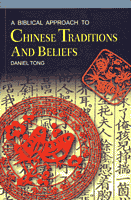
I eventually came to my own conclusions about these and many other questions. If only Daniel Tong had published this beaut little book thirty years earlier! It is a short book, clear and concise, simple without being simplistic, and full of the wisdom which comes from years of research and teaching. He is a graduate of Trinity Theological College in Singapore.
Tong begins by explaining how traditional Chinese belief and practice is very much syncretistic, influenced by Confucianism, Daoism, Buddhism and Shenism (folk religion). He then examines “Festivals of the Living” such as Chinese New Year, and then the many “Festivals of the Dead” (this is where ancestral worship fits in). Tong’s method is to describe the particular tradition, examine its cultural, historical and religious roots, offer a theological analysis and then a pastoral way forward – and does all these things with clarity and biblical insight.
At first sight, this book may seem relevant for only Chinese Christians (or Anglos thinking of marrying a Chinese person – see the chapter on marriage traditions!), the other subjects covered means it actually has much wider relevance and application: reincarnation, Feng Shui, incense and joss sticks, Chinese medicine and herbal treatments, Yin-Yang, acupuncture, meditation, the flow of qi in the human body, and Kung Fu. These and other Chinese traditions are gaining popularity at the rate of knots in our society, and are seen as very much alternatives to Christianity or Western thought.
If you are a Chinese Christian, buy this book. If you are discipling a new Chinese Christian, then this book will be invaluable. If you have a Chinese neighbour (and with increasing numbers of Chinese migrants, you soon will if you haven’t already) then this book will help you to shine the light of the gospel into their dark, syncretistic and superstitious thought world. If you wonder at the fascination many Australians have for Chinese medicine and spiritual practices, then this book will serve as a great introduction.
Ivan Lee is the Bishop of Western Sydney.