Ever since I was a member of the General Committee of the Christian Conference of Asia, and then one of the presidents of that regional ecumenical organisation, I have had a profound interest in the nation of Burma, its people, and especially Burmese Christians.
 I recall being deeply moved one morning when we were meeting in Osaka, Japan. I breakfasted with the representative from Burma in a busy local café. We appeared to be the only non-Japanese in the place and the only English speakers.
With my normal Aussie blunt talking, and in my ignorance, I asked, "Why don't you share with us more openly about the situation for your people and the Christians in your nation?".
The quiet reply was, "Because if I did, when I go home, I might disappear".
Burma is a nation in South-East Asia with a population of about 50 million. Since 1962 it has been under military rule, following the coup staged by General Ne Win, when the civilian government was toppled. In 1988 the current junta was formed, and in 1990, the junta suspended the results of a democratic parliamentary election, and the successful leader in that election, Aung San Suu Kyi, has been under house arrest ever since.
There are nearly four million Christians in Burma, and they are regarded as part of the worldwide persecuted church. Minority ethnic groups in Burma, including the Karen, the Karenni, Chin and Kachin, all include quite large Christian populations. Christianity Today reports that the US State Department ranks Burma as one of the six worst violators of religious freedom.
Informed observers now believe that the military junta plans to eradicate Christians from Burma so that it will become a wholly Buddhist nation.
Stories from Christian pastors and refugees in the camps on the Thai/Burmese border, where they have been ministered to by many Christian missionaries and church representatives, and NGOs, give a clear picture of what is happening to the oppressed people. They report that Christian churches, villages and homes are destroyed and burnt to the ground. The majority of Burma's Christian population are Baptists, but there are other Christian groupings, including the Anglican Church.
The Anglican Primate is Archbishop Samuel San Si Htay. He is an inspiring man, slim and wiry like the majority of his people, and full of Christian courage in his witness and leadership. Like most Burmese he has to be careful about his comments on the situation in his country while outside Burma.
There are many human rights abuses. People are compelled to become human minesweepers, men are taken from their homes to be forced labourers, children are seized and turned into soldiers, and the use of rape as a weapon of war and control of the people is well documented.
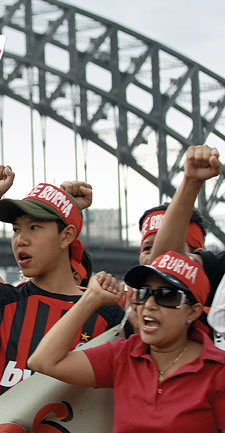
In August this year, the regime dramatically increased the cost of petrol. As a result, there were uprisings which grew into the marches that we saw reported in our media, with many Buddhist monks joining in the protests. There was an immediate crackdown from the military forces, many people were seized and taken away, beaten and tortured. One Japanese journalist died while filming events. He was not holding a weapon and he was shot in the back.
A Bangkok Post journalist wrote that Rudyard Kipling described Burma as a land full of "sunshine, palm trees and tinkly temple bells", but now he said, "its people are at risk of being felled like trees in a far-off forest, invisible and all but unheard".
But hear the words of a pastor to a Christianity Today journalist who had found his way into remote parts of Burma. "We have to leave village after village, house after house. But it increases our faith. We are Christians; we know that God will help us. But please remember us in your prayers. Please do not forget."