Starting a Bible school without books or buildings, visiting parishes where there are no roads, sending messages where there is no post, running seminars where participants don’t have Bibles…these are just a few of the challenges myself and my wife and Elizabeth Richards have faced in the two years since they came to work for the Diocese of Kindu in the heart of the Democratic Republic of the Congo (DRC).
 CMS currently has three missionaries working in the Diocese of Kindu, DRC. The diocese was inaugurated in 1997 and Bishop Masimango Katanda was consecrated at the same time. CMS has a long association with the diocese but for the 7 years of war little contact was possible. During that time many Christians, including pastors, fled their villages, churches and schools were destroyed or fell into disrepair and the diocesan offices lost most of their equipment. Bibles and TEE books were also stolen or lost. There were many deaths and the population was left starving and traumatised by what they had seen and experienced.
Despite this, the diocese has grown in 10 years. There are churches in all parts of the province of Maniema where Kindu is the capital. However many of these parishes are far apart - sometimes over 100km with no roads or means of communication. The churches are growing but there are many obstacles to
Growth, apart from the physical problems of isolation, lack of church buildings and lack of infrastructure throughout the region. “The harvest is plentiful but the workers are few” was the theme of the recent 10th anniversary celebrations. Pastors, evangelists and lay people were challenged to take this work more seriously and to preach the full gospel.
As missionaries of the diocese we are continually challenged as to how best to prepare and train people for the work of church planting and church growth. I have been appointed as the director of the Diocesan Department of Theological Education. The first task given to us by Diocesan Council has been to establish a new Bible School for the diocese with new criteria for entry and a new syllabus. Finding the right students has been a challenge. We have looked for men and women who are committed Christians, have at least three years of secondary education and are already using their gifts in ministry.
We find however that lots of people want to be clergy for the wrong reasons, or people want a chance to study something- anything! It is taking time to make an interview process part of established practice but already it is making a difference. The vision is new and it has been hard to sell it across the diocese, particularly in isolated places where we have not yet visited, but also in places where they cannot find anyone who fulfils the requirements - especially three years of High School. We have found ourselves involved in change management. This has mainly focused on working with the eight archdeacons to get the diocese as a whole to own the new initiatives.
In the Bible School we want to prepare the students for the challenges they will face in ministry. These are the same challenges faced in the “missionary archdeaconries”. Islam is strong in the south part of the diocese. The Arab slave traders built towns and many converted to Islam. We have just accepted an ex-Muslim into the Bible School in the new intake. Kalume is older than we would prefer and has only first year high school but the decision was made to accept him as his people group is so resistant to the gospel and it is important to have someone from his area given Bible training.
As well as Islam, many sects have appeared since the war and Christians have not been taught to discern the dangers of false teaching. People also have a syncretistic approach to Christianity and mix it with their traditional beliefs.
There are almost no suitable teaching materials or books that meet our needs. Our students and pastors speak Congolese Swahili with a little French. Most theology books are in English. Those that are in Swahili are published in Tanzania where the Swahili is significantly different. We have translated some materials and printed them on our home office equipment. However it is time consuming and expensive. Whatever we produce for the students, the pastors and other church leaders ask for as well. Many of them had a small home library before the war but almost all books have perished.
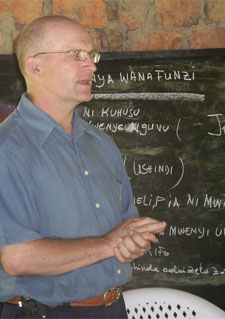
Another challenge in the Bible School and in training seminars is actually getting the message across. Many of the people we are training have low levels of education with low levels of written comprehension. They are accustomed to a rote learning system where students copy notes off the blackboard. When we introduce different methods the initial response is “this isn’t education”. We find our students are not used to critical thinking, and because Maniema is so isolated there is limited exposure to different ways of doing things and there is much resistance to change. Many new ideas are simply not heard.
When we started planning the Bible School there were no buildings, classrooms or student housing, no books, no food, and few teachers. God has provided in miraculous ways and through the generosity of Christians, including the Diocese of Sydney through the Archbishop’s Overseas Ministry Fund. However the work involved in establishing the school is enormous. Our students have to come as singles leaving family behind - we want to be able to provide a Bible School where both husband and wife can be prepared for future ministry but at present we have no adequate facilities.
Despite the challenges, things do happen here in Maniema. Messages get sent via community radio stations and payment by sending credit to someone’s mobile phone. Mobile phone companies are gradually expanding. Bridges eventually get repaired. Our students at Bible School get excited by the teaching they receive and their new understanding of the Bible. The Bible School teachers have adapted to new ways of teaching and a strong team is being formed. Two of our teachers have received further training in Tanzania through CMS bursaries.
The challenges are enormous. Please continue to pray for us and for Bishop Masimango as he leads the Diocese, that Christ would grow His church in DR Congo.