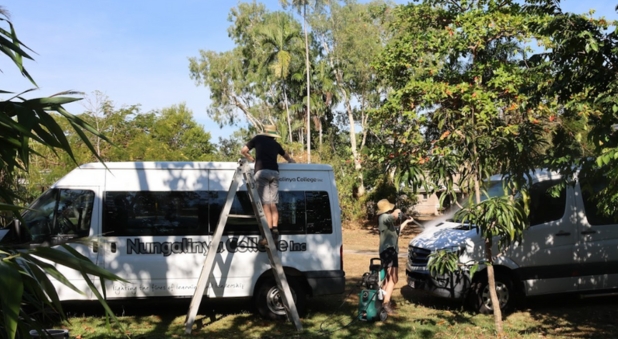
Swapping the cold of Sydney for the sunshine of the Northern Territory, volunteers from 11 different churches gathered at Nungalinya College in Darwin last month, sleeves rolled up and ready to get to work.
Since 2014, this bunch of volunteers have spend a week at Nungalinya each year, carrying out maintenance work essential to keep the Indigenous Bible college running. Gutters are cleaned, gardens are weeded, and it’s all part of partnering in God’s work across Australia.
The partnership started when some members of St John’s, Mona Vale were travelling around the Northern Territory, exploring ways that their church could be involved in supporting Indigenous people and ministry.
“We were driving around [the NT] and saw Nungalinya, and the sign said ‘Lighting the fires of learning and leadership for Indigenous communities’, so we pulled into the carpark,” says Mark Corbett-Jones, one of the trip’s co-ordinators.
“We sat down with the principal and she talked about what Nungalinya was doing. We thought, ‘That’s fantastic!’”
The first group travelled up with 16 volunteers – a mix of builders, librarians, architects and more. As the years have gone by, they’ve found themselves involved in tasks big and small, from painting, filing and cleaning to designing new buildings. This year the team came from 11 different churches, including eight Sydney Anglican churches from St John’s, Mona Vale on the northern beaches all the way south to Austinmer.
Mal Galbraith, property manager at Nungalinya, is thankful to have these volunteers sharing in the vital work of the college.
“It is a two-way street of learning and supporting each other,” he says. “The college benefits [from] the work hours contributed and the fellowship. They all come with a willing heart to serve and do anything that is asked of them.
“The volunteers benefit by being exposed to the mission of the college, by learning how the college supports the partner churches to train and equip students who come to the college. They learn aspects of cross-cultural work with our First Nations people and hear first hand from staff and students sharing stories of life and faith.”
For Mr Corbett-Jones, the relationship between the team and Nungalinya is the heart of the partnership. “There’s no hard words, everyone knuckles down and does the work, everyone is here for the same purpose, and everyone is pulling their weight and serving. Everyone is smiling. It’s joyful.”
Each year team members are changed as they hear from members of the college and Indigenous community.
“When people come up here and see the Christianity and Indigenous Christians, it changes a lot of things,” Mr Corbett-Jones says. “We go back with a much bigger appreciation of Aboriginal culture and what’s going on in the Top End.”
His prayers are also shaped by each visit. “I would ask for prayer for the Bible translators here – they need more staff to help translate the Bible for Indigenous people. Without having Indigenous-translated Bibles, these people aren’t getting the gospel!
“Continue to pray for the college and the students who come. They come a long way and experience a lot of obstacles to get here.”
Jess Dinning, Austinmer
On any day in this year’s NAIDOC week, the suburban grounds of Nungalinya College were receiving a touch-up. I was weeding the shady spots of their “Garden of Eden”.
Others were offloading mulch into garden beds around the cabins. Some were repainting a classroom, while others were in the air-conditioned office digitising files and sharpening pencils. This was a five-day working bee, a trip I participated in last year and eagerly did again.
But why? Asking myself this immediately prompted the word “fun”, but I knew there had to be something God was stirring within me. Flights to Darwin are not cheap – why would I sacrifice hundreds of dollars, and a week of my uni break, to garden in 30-degree heat?
Visiting Nungalinya College both refreshes and encourages my soul. Not only does it bear witness to the strength of faith in brothers and sisters outside my church, it teaches me a different kind of spirituality. God is bigger than the practices of one denomination; Christian living does not have to solely follow the Church of England.
However, what I enjoy most about the Nungalinya mission trip is that it fosters reconciliation in a way that is genuine, requested, practical and removed from politics. Everyone is equal in God’s family.
This trip is not a situation where we have come to mulch because our way of mulching is superior, but an example of God’s family serving one another because that’s how his kingdom turns. And, sometimes, that can be as simple as seeking shade, squatting in the soil and pulling weeds from a garden designed to artistically represent the Creation story.