What are the later years of life for? Too often we think of growing older as finding time for ourselves – travel, fun, and all those things we have never had time for before. Often lying behind this is a fear of getting older and being of no use to anyone.
Do you look forward to being older? This question is often answered with a proviso “As long as I am healthy”. These attitudes, in my experience, are spread fairly evenly across the community, among Christians as well as those with no faith affiliation.
Let’s unpack what it means to grow older.
It depends on how we look at ageing. Are we won over by the secular push for wealth and wellbeing? Do we, with most others, ask “Is that all there is”? Or perhaps, as St Paul saw in Philippians 3:14, there is still the last and greatest race of all: to push forward towards the prize.
In these days of longer and generally healthier life, certainly in Western countries, we may fear ageing, frailty and dementia; most people I have asked over the past three decades have told me they fear getting dementia.
If we take Paul’s view, how do we learn to live differently for the sake of the next generations?
It may help us if we regard these later years as the “final life career” and then ask how that changes the way we view growing older. In other words, what are added years of life for?
I contend that the final life career is just as important as all that has gone before, and it challenges us to respond to how we have and will use the years given to us. As grandparents, we have some work to do in searching for God’s meaning in our lives, so that we can be confident in how we engage with our grandchildren.
The only way I have been able to make sense of these added years is to put God at the centre. These years are God-given, and therefore there must be a purpose to them. It is our task to search for and find that purpose, as it is only in understanding our own ageing more fully – and especially our spiritual lives – that we can live out the full hope God has in store for each of us.
Jesus came that we might have life and have it in abundance (John 10:10); this is part of the new creation Jesus ushered into the world through his birth, life, crucifixion and resurrection.
The spiritual tasks of ageing
Two tasks lie before older adults: first, knowing who we are in the sight of God, through Christ and the power of the Holy Spirit; and second, handing the baton on to the next generation, whether that be our grandchildren or other younger people.
Another important thought is that our bodies are the temple of the Holy Spirit (1 Cor 6:19), so we therefore need to care for our ageing bodies if we want to continue to live well and give of ourselves.
These later years have real purpose for each of us. These are the years in which we are able to search for and find meaning, with answers to questions that began in mid-life, such as “Who am I and why have I been here?”, and “What is the meaning of my life?” These are deeply spiritual questions that take on new meaning for many older people.
It was with these questions of meaning and hope that I began an intentional journey of discovery in the 1990s to explore with older people where they found meaning in life. This culminated in doctoral studies and the development of a model of spiritual tasks and process of ageing (The spiritual dimension of ageing: Meaning in life, response to meaning, and wellbeing in ageing, 1998).
Since I began my research, story and reminiscence have gained in popularity, particularly in the secular society, and a popular term is “meaning making”. I take a different approach – that we as Christians don’t “make” meaning but, rather, search for, struggle and seek to find meaning in our lives through reflection and prayer.
This search for meaning becomes accentuated in later life, perhaps as we become more aware of our ageing bodies, or loved ones die and our own mortality is highlighted.
How do we grow into Christ? And especially, how do we grow into Christ in our later years? An important means of growing into Christ is through story, reflection on Scripture and also reflecting on our own life journey (reminiscence) to find the final answers to our questions of life's meaning and purpose. American psychiatrist and gerontologist Robert Butler wrote that reminiscence is important for older people, as it is the last chance we will have to find answers to these questions. It is in one sense like Augustine’s statement that our hearts are restless until they find their rest in God.
It is natural to find meaning through story; Jesus used story widely to communicate with his listeners. Humans seem wired to connect through story, or narrative. A special way that Christians can utilise this is a method of reminiscence connected with meaning called “spiritual reminiscence”.
In this process, our stories are not simply historical, factual stories so much as the story of faith and hope and the deep connections between family members, and how – guided by the Holy Spirit – we grow to understand our stories.
Where we find meaning
In my initial studies, being aware of the proportions of the Australian population holding a religious faith and those with no faith affiliation, I chose to include people with faith and without in the study. This resulted in the construction of a generic model of the spiritual tasks and process of ageing, as well as a model for those with a Christian faith, as it was easy to identify how a Christian approach differed from a secular one.
This study sought to find whether there were specific developmental changes in a spirituality of later life, using a survey of spiritual wellbeing in later life and in-depth interviews of older people living independently.
The interviews produced rich data on where participants found meaning. It was seen in two ways: first, provisional meaning – which, in a sense, was associated with life process, at the time of the event – and then final or ultimate meaning being assigned (if at all) near the end of life.
The model developed in the study identified six main themes. The first four are continuums:
- self-sufficiency to vulnerability
- provisional meaning and process of moving toward final meaning
- relationship to isolation
- hope to despair or fear
The remaining two themes are response to meaning, and final or ultimate meaning.
Ultimate meaning lies at the heart and is linked with growing into Christ in the latter years. The themes become the ongoing model of spiritual tasks and process of ageing.
Meaning is found especially through relationship, with others and/or God; through creation and creativity; through the arts; and in religion through liturgy, religious services, symbols and rituals that carry meaning for the people and sacred texts.
The model became the foundation for developing programs of spiritual reminiscence for individuals or small groups of older people with a group facilitator, often in parish settings, where participants met together weekly over about six weeks. Participants reported growing in their faith and felt more connected with others in the group, in some cases leading to strengthening and continuing relationships after the group had ended.
Another small group program we developed was scriptural reminiscence. This guided participants engaging in depth with biblical stories, seeking understanding in relation to God’s purpose in their lives.
True meaning
At no time in life does meaning cease to exist, although it may be hard to find meaning in some situations. Searching for and finding ultimate meaning in our later years may take us back to unresolved matters from a long time ago, but it offers the opportunity for healing and hope, that we may continue our life journey growing into Christ.
Too often we are caught up in the noise of a society that craves our attention, while the Hope of the World is waiting for us to open our hearts to him so we may grasp this treasure that is God’s and ours.
It is this growing ever closer to Christ that enables us to find ourselves in Christ amid life’s busyness. It takes away the fear of loss as well as the superficial trials that would engage us.
Finding meaning in life remains crucial for many older people and is often accentuated as a person becomes more acutely aware of the nearness of end of life. But, returning to a topic raised at the beginning, what about dementia, when memory is failing or recall dysfunction may exist? Helping people with dementia to connect with meaning is one of the most important things we can do to support them, even as cognitive function declines.
While cognitive abilities may continue to be lost, the search for meaning and sense of meaning at the very core of our being remains, and it is through the spiritual, through connecting with meaning, that life can remain worth living for these people. This deep level of connection beyond language is profound and connects with the spiritual and ultimately with God.
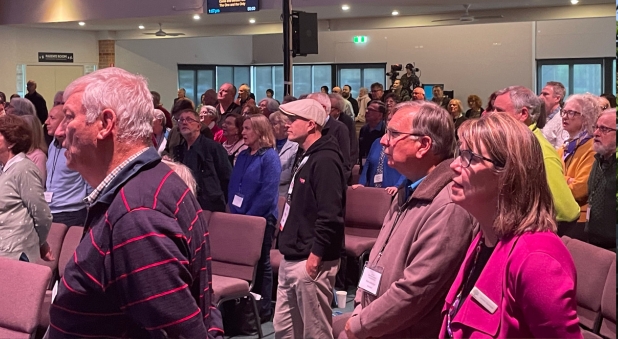
This is an edited version of a talk given at the National Grandparent Conference.
The Rev Professor Elizabeth MacKinlay AM PhD MEd is adjunct research professor at the Australian Centre for Christianity and Culture and School of Theology at Charles Sturt University.