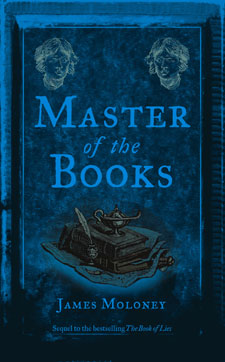
Is it possible to deceive when telling the truth? This was an intriguing question raised by James Moloney in his children's fantasy novel, The Book of Lies, published in 2004.
Here he introduced three children, Marcel, Nicola and Fergus who are not only kidnapped, but whose memories are removed from them by a powerful wizard.
 The Book of Lies follows their quest to discover their true identities and, as the pieces slowly fall into place, their attempts to save the kingdom of Elster from its enemies. Along the way they are hindered, rather than helped by the Book of Lies, a remarkable book which is able to discern whether or not someone is telling the truth or not. Because the Book of Lies has been infected by the same evil that threatens the kingdom of Elster, it deceives even when revealing whether truth or lies are being told.
At the end of The Book of Lies, most of the questions are answered, most identities revealed, most enemies defeated and most of the Book of Lies is destroyed. But some questions and problems remain unresolved and fortunately Moloney's sequel, Master of the Books ties up all the loose ends and provides us with a highly entertaining story to boot.
The key question that remained at the conclusion of The Book of Lies was that of Fergus' identity which is fairly quickly resolved in Master of the Books. A new problem arises for Fergus (which he remains unaware of for much of the book) as he seeks to destroy Damon, the remaining unvanquished enemy. This is due to Marcel testing out his growing magical powers by conjuring a specific curse which he believes will protect Fergus but may destroy him instead.
As the story progresses Marcel and Nicola struggle to grow into their newly discovered identities as Master of the Books for Marcel and future queen of the kingdom for Nicola. We follow their journey as they seek to save Fergus from experiencing the evils of the curse and grow into their new roles.
Moloney raises the issue of good and evil in this book and Marcel spends quite some time thinking through the nature of the human heart. As he revisits a memory of a time spent with his now-deceased mother, she says to him, "Not soft-hearted, Marcel, good-hearted" . How could I encourage you to master your gifts if you weren't good at heart? Evil can grow in the human heart, too, Marcel, great evil". As Marcel reflects on his mother's words, he declares, "Every human being has a heart" but some are filled with envy and greed and they don't care who suffers as long as they get what they want".
As is unfortunately typical in both children's and adult fantasy, good and evil exist, but evil, powerful as it is, can apparently be avoided by some as they have a "good heart". Some people are evil and some are good " all quite a long way from God's declaration about the human heart in Jeremiah 17:9, "The heart is deceitful above all things and desperately sick".
There is no external saviour in Moloney's books " Marcel and his friends are able to vanquish evil by using their powers for good. They are able to turn their backs on the temptation that evil offers them. And so, this story remains firmly in the realm of fantasy. God's word tells us that we all need a saviour, that none of us can defeat evil on our own and that, left to our own devices, we'd really rather choose evil over good. Have a look at Romans 1 to 6 for God's perspective of the issue of good and evil and the human heart.
Master of the Books is a well crafted and highly engaging children's fantasy novel with the usual suspects of fantasy creatures, medieval castles, an evil sorcerer and a reluctant hero. Read it with your children, by all means (my whole family loved it!) but make time to read "The Book of Truth', namely, the Bible with them, too, so that they (and you) will be in no doubt of their need for a saviour who will never deceive them, never let them down and who has totally defeated evil.