The Archbishop of Canterbury's response to controversial decisions by the US Episcopal Church is "a turning-point' that gives hope to conservatives around the world, says the Archbishop of Sydney, Dr Peter Jensen.
In a statement released at a press conference yesterday, Dr Jensen says Archbishop Rowan Williams has provided "a great service' to the Communion by recognising that "a separation within the Communion is inevitable'.
However, Dr Jensen adds that Dr William's plan to move towards two levels of relationship in the Anglican Communion was being "more optimistic than I would be'.
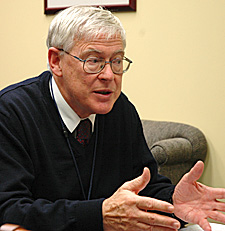 "I think the loosening of the ties has already occurred," he explained in answer to media questions.
"We will continue to operate more like a series of networks."
In a statement released on Tuesday, the Archbishop of Canterbury responded to the US Church’s General Convention, held last week in Ohio, by saying the ‘structures of the Communion had struggled to cope with the resulting effects’ of the consecration of a practising homosexual bishop in the US three years ago.
Dr Williams recommended that the Communion could be held together by dividing into a ‘covenant’ of local churches who would make a commitment to each other.
He suggested that those outside this fellowship would remain ‘in association’ with the Communion by historical ties but not be part of decision making.
He said the relation would not be unlike that between the Church of England and the Methodist Church.
Dr Jensen said Dr Williams was still focusing on how to maintain unity but that it would be best to accept that the Anglican Communion was already more fragmented than just two entities heading for divorce.
"It occurred in 2003 when Bishop Robinson was elected," referring to the election of the Bishop of New Hampshire, Gene Robinson, who lives with his male partner.
"Bishop Gene Robinson's ministry, in principle, is restricted in many parts of the world."
So will the Archbishop of Canterbury's position make it easier for Sydney Anglicans to support their friends, like the Rev David Short from St John's, Shaunnessy in Canada who is currently "out of communion' with a diocesan bishop who authorised a liturgy for blessing gay unions?
While Dr Jensen believes that "local problems should be solved locally where possible', he says the statement gives hope to conservatives like David Short because the Archbishop of Canterbury has recognised that, "this is a Bible matter'.
"You don't have to read between the lines to see the Archbishop of Canterbury is being critical of the Episcopal Church," he says.
“The presenting issue may be human sexuality but the real issue remains the word of God.”
Dr Jensen dismisses any notion that the conservative agenda is really about power politics, saying that it was the liberals who had been seeking to introduce the innovations.
"To take St John, Shaunnessy, for example, they have stood where they have always stood," he says. "It was the Diocese [of New Westminster] which brought the innovation.
"The conservatives have attempted to save their own ministries and call the church back."
Archbishop of Canterbury's plan unworkable
Dr Jensen said it was unlikely that the Australian Church could ever sign onto the sort of covenant that Dr Williams recommends as a way forward because of the nature of its constitution.
Any significant piece of legislation in Australia needs to be passed by a majority of General Synod members and then passed by the Synods of every one of the five Metropolitan Sees: Perth, Adelaide, Brisbane, Sydney and Melbourne.
"It is unlikely that Australia would enter into a set of relationships that would compromise their independence," Dr Jensen said.
This dynamic is repeated on the international stage.
"It is difficult to think of a covenant that different churches would buy into," he said. "We are used to our autonomy."
Asked if the ordination of women was an issue that made a covenant difficult, Dr Jensen said it was, "the elephant in the boat'.