The First Hymn
Rated G
A little over a century ago, a scrap of papyrus was discovered outside what remains of the ancient Egyptian city of Oxyrhynchus. This 30cm x 5cm piece of papyrus from the second century AD was among half a million fascinating remnants found from official documents, plays, philosophy and more, dating back up to 2300 years.
This fragment stands out because it’s a Christian hymn of praise to the Father, Son and Holy Spirit – written a hundred years before the Council of Nicaea formulated a creed to underscore the doctrine of the Trinity. It’s also the earliest known hymn to include musical notation.
That’s why the documentary The First Hymn has been made: because this is a song that was sung by second- and third-century Christians in a city that no longer exists. The First Hymn seeks to share this with us and find a way to introduce it to a new audience.
Sydney Anglican historian, academic and self-proclaimed “wannabe musician” the Rev Dr John Dickson is thrilled that this little slip of papyrus not only shows us what Christians were teaching in that era, but what they were singing. He’s determined to somehow bring the song back to life but recognises that “we can’t just slap an English translation onto an Ancient Greek tune! With all due respect to the original composer, the melody is a little weird to the modern ear. We have to find a fresh way forward”.
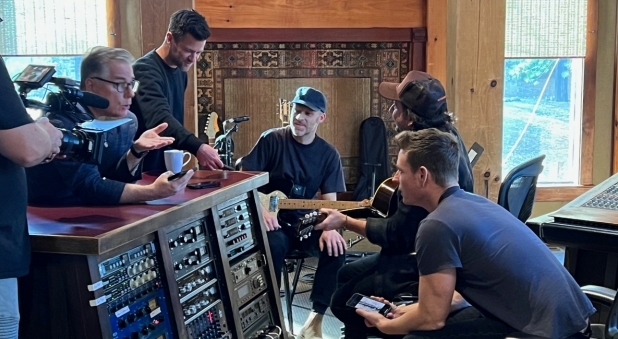
So, armed with his own translation of the text (see inset), Dickson drops in on his friend Ben Fielding, who has co-written Australian Christian songs such as “This I Believe (The Creed)”, “Mighty To Save” and the Grammy-winning “What A Beautiful Name”. Fielding is keen, ropes in Christian music superstar Chris Tomlin, and The First Hymn Project is off and running.
Somehow, the writers need to balance the ancient with the modern, add new lyrics without swamping the content from the papyrus, and – as Dickson puts it – combine “pop sensibility with a hymnic gravitas”. They also need to decide whether they can, or should, incorporate any echoes of Egyptian singing in homage to the hymn’s origin.
No pressure then.
While the musicians do their work, Dickson continues to fill out the context for us, providing everything from the culture of the ancient hymn and its music, to what makes a good modern worship song. We even get a choral rendering of the original hymn by a choir at Wheaton College in Illinois before the finished new song is premiered at a Chris Tomlin concert. More of that in a moment.
As a history nerd, I loved the wealth of historical and theological detail in The First Hymn and was also fascinated by the musical journey it took us on. While expert observations weave in and out of the narrative, Dickson’s input helps to keep the language and style accessible – and his palpable enthusiasm is engaging.
But back to Tomlin and Fielding’s new take on the ancient hymn.
Perhaps it was learning a little about the early church, where the original song was born, and hearing the tale of its rediscovery. Perhaps it was the knowledge that Christians in Oxyrhynchus worshipped the same God – Father, Son and Holy Spirit – and had the same trust in Jesus’ death and resurrection. Perhaps it was seeing these ancient words bridge an 1800-year gap to be sung once more.
Whatever the reason, when the documentary showed us the new song’s first live performance, it brought tears to my eyes. Yep, I cried. It was a morsel of food for the soul, and to be honest the song has been in my head ever since.
It may not rival some of Tomlin and Fielding’s other works in terms of commercial success, but this reworking of the first hymn reminds us of eternal truths: that all creation knows our God is mighty, and that we can have a deep, abiding joy and confidence in the salvation won for us.
The First Hymn is in cinemas for one week from July 31. See here for screening locations.
Hymn translation from Ancient Greek
Let all be silent:
The shining stars not sound forth,
All rushing rivers stilled,
As we sing our hymn
To the Father, Son and Holy Spirit
As all Powers cry out in answer,
“Amen. Amen.”
Might, praise and glory forever
To God, the only Giver of all good gifts.
Amen. Amen.