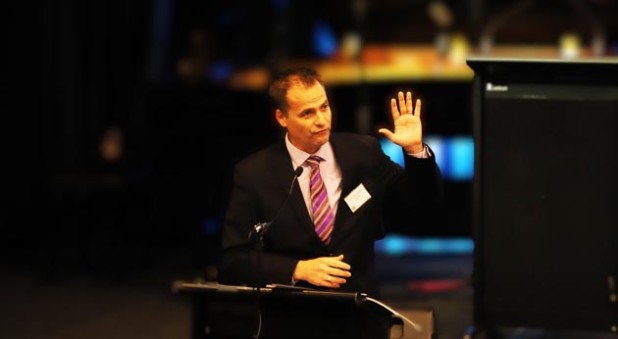
In yesterday’s afternoon session, Synod approved a motion encouraging parishes in the Diocese to focus on increasing church attendance by 5 per cent each year until 2030.
This grew from a report prepared in response to attendance decline in diocesan churches between 2013 and 2023, and a motion at last year’s Synod expressing repentance for where “we have fallen short in not giving sufficient priority, attention, reflection and resources to seeing the lost throughout the Diocese of Sydney saved by Jesus”.
The mover of the motion (and a member of the committee that prepared the report), rector of Norwest the Rev Pete Stedman, said on the first night of Synod that “potentially, the [report’s] most significant recommendation is that we collectively work together for the next five years to focus on responding to our attendance decline by attempting to see a five per cent growth in each of our churches – and each year – by seeing people saved”.
As rector of a large and growing church, Mr Stedman told Synod members he had believed Norwest was doing well in evangelism until he was invited to join a Reach Australia leadership program and take part in a church consultation.
The subsequent report, although “bruising” to read, is something he now thanks God for, “because it started us on a four-year plan to rethink, replan, reshape and restructure pretty much everything. And one of the things that struck me from the report was how few people were coming to know Christ at Norwest... Four people, from a church and a ministry of more than 800 people.
“And so, a number of years ago, I stood before our church and told them I was sorry. For leading them to believe that we were better at sharing Christ with people than we actually were. And that, as a ministry team, we were going to reflect on that and do better – lead better.”
Mr Stedman said that in 2021, Norwest’s conversion rate against average its Sunday attendance was just under half a per cent. By 2024, this had grown to 4 per cent. In the past 12 months, 30 people at Norwest made first-time commitments for Jesus, something he said “would not have happened without the help I got. I realised I needed to do better; and I realised I needed help”.
Seconder the Rev Canon Craig Roberts spoke to the youth focus the motion encouraged, telling those present that 78 per cent of people who attend diocesan churches made a decision for Christ before they turned 18 – noting, among other things, that “the largest 25 churches in the Diocese had each made significant, long-term investments in youth and children’s ministry”.
“You may not have many young people in your suburb but the majority of us do,” he added. “This motion calls on every church to strive to increase your allocation of resources year on year over the next five years to this most fruitful of mission fields that is in your streets, in your schools, right at your door. Consider your church’s mission and ministry plans through the lens of ministry to children and youth.”
The nations, other ages and flexibility
Subsequent debate raised a range of issues, such as the need to include in the motion the many thousands of people in our suburbs and towns from a non-English speaking background; and the importance of churches’ focus to go beyond children and youth to entire families, and to adults and seniors.
Some speakers were concerned the motion was too prescriptive, and that including any percentage was unhelpful. Others thought the growth goal should be higher.
A lay member from North Sydney expressed the concern of a number of speakers that the motion could result in a focus of resources only on children and youth, with “embarrassment” for parishes that did not attain the five per cent goal with this cohort.
He added that, although Canon Roberts had noted that 24 per cent of the population was under 18, this meant that 76 per cent were adults. He noted that his wife was regularly approached by acquaintances keen to know more about faith, asking her to read the Bible with them.
“It’s great to include resources for ministry, but I’m cautious about saying it should be to youth and children every year when there are other groups to focus on,” he said. “[I want] parishes to focus wherever they should... because our God wills that all be saved.”
Rector of Christ Church Inner West, the Rev Andrew Katay, challenged Synod members with these thoughts: “What if it happened? I mean, praise God, but what if it happened that each year for the next five years, 5 per cent became believers and joined the church? [There will be] whole groups of brand-new Christians and what’re you going to do with them?
“Churches don’t come as single focus entities. The Great Commission doesn’t come as a single-focus entity. Jesus said make disciples of all nations, baptising them and teaching them. So, if it worked, we’d be investing as much in discipleship as evangelism – and we should [or] evangelistic efforts would be fruitless.”
Members voted to put aside the motion until the second sitting day to consider all that had been debated. The final motion included pastoral flexibility, an invitation rather than commitment to join the five-year focus, and an encouragement to shape resources appropriately towards youth and children – as well as those from other nations living among us, in “culturally responsive and cross-cultural ways”.
Synod also gave thanks to God for two years of consecutive growth in church attendance. And, although there may have been some disagreement over how to go about it, the essential desire of all mirrored that expressed by Surry Hills rector the Rev Toby Neal: “To give great thanks to God for the growth he is sending and to keep calling God to do far greater things... to save many, many more thousands of people through the gospel of Jesus”.