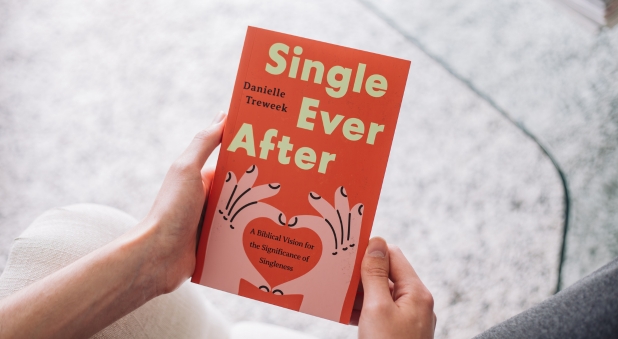
Single Ever After by Danielle Treweek (The Good Book Company)
Based on data from the 2016 National Church Life Survey, about 35 per cent of our church population over the age of 15 are single; either never married, divorced, separated or widowed. That’s a lot less than the two-thirds who are married. But if you imagine a church of 100 people, that’s 35 people who potentially feel lonely, frustrated, totally fine and everything in between.
Maybe they’re okay with being single. Maybe they aren’t and come to church not sure where to sit and shoot off straight after the service because they don’t know who to talk to. Or maybe they relish new conversations.
Maybe they love the time they have to serve. Or maybe they feel desperately lonely and pray in anguish every night, asking why God hasn’t provided a spouse for them. Maybe they are sick of being expected to always be on serving rosters. Maybe they are so frustrated that singleness is supposed to be a “gift” when it feels like a backbreaking burden.
And perhaps they feel all of these things at different times on different days. We are, after all, complex creatures, and God did not create us to be emotionally monochromatic!
This is where Danielle Treweek’s book is so deeply needed. Her previous book, The Meaning of Singleness, was what reviewers often call “magisterial” – which I think just means long. I mention it here as a positive, as it provides detailed biblical and historical explorations of singleness in the Bible, through the lens of the early church and the church today.
Single Ever After is much shorter and, while I would say The Meaning of Singleness is accessible, Single Ever After is a very easy read. For all its ease and speed, though, it certainly packs a punch. It tackles the very heart of singleness from a theological perspective as well as lived experience – each chapter including the biblical exploration of an issue and a “living it out” section for real-world application.
It begins with examining the balance regarding the place of marriage and singleness in the family of God and how we individually relate within that broader family. As Treweek helpfully points out, “The church is not an affiliation of individual families who happen to meet together in the same place at the same time. No, the church is one new family”. And “Before (and after) we are someone’s spouse, we are their sibling in Christ”.
The book also tackles issues like the “gift” of singleness and whether that is actually a real element of the Christian life or one we’ve taken from an out-of-context verse and run with; aloneness and the means by which God’s “not goodness” of being alone can be answered through a multiplicity of relationships; intentional singleness and circumstantial singleness; celibacy and sexual temptation – and a range of other topics that are of profound importance to the single person.
Here's the kicker though. While the subject is singleness, this book makes excellent reading for married people as well. It helps explore how husbands and wives might relate to each other and others in the church as brothers and sisters in Christ. It looks at how the so-called gift of singleness has implications for the gifts that married Christians are also supposed to have, and whether married people get a free pass to be distracted from kingdom priorities because they have families.
I would recommend reading The Meaning of Singleness as well as Single Ever After. The former is longer but each book is distinct, and both are incredibly helpful in different ways.
Single Ever After is thoughtful, wise, practical, helpful and provides insights that I have not had the ability or the language to explore before. I am deeply grateful as a single-again person to have the gift of this book to help me think theologically through my situation.