John Stott grew up in London's All Souls, Langham Place Church of England, and in 1945 was ordained as assistant pastor. He has served that one church ever since, including 25 years as rector, and 30 years as rector emeritus. But throughout his life he has also served the wider church in his worldwide ministry of speaking and writing.
His first book, Men with a Message, was published in 1954 and has been recently revised by Stephen Motyer as The Story of the New Testament. He founded The Bible Speaks Today series of expositions in which may of his own works appear.
He has written comprehensive, readable explanations of Christian teaching, including The Cross of Christ, which now appears in a 20-year anniversary edition, biographical books such as his People My Teachers and even a book about his lifelong fascination with birds.
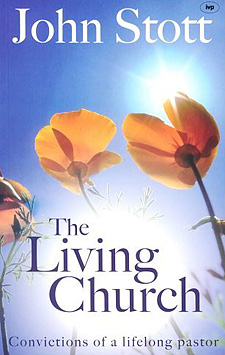 Although he retired from his preaching ministry after addressing the Keswick Convention in July this year, he continues to publish significant books including his fiftieth, The Living Church. Here he shares God's vision for a learning, caring, worshipping and evangelising church. At the very beginning he reminds us that to be a Christian is to be committed to the body of Christ, despite its imperfections. "I trust that none of my readers is that grotesque anomaly, an unchurched Christian," he says.
Stott sees value in new expressions of the church and warns us that traditional and "emerging" churches must listen attentively to one another. What the world needs is ‘radical conservative’ churches which conserve what Scripture plainly requires, while combining traditional and contemporary cultural attempts to be Christ's church today.
His articulation of five paradoxes of preaching is worth reflecting on, as is his thoughtful chapter on giving, which provides ten guidelines drawn from 2 Corinthians 8 and 9. He heartily endorses setting up bank transfers for church and mission giving as being in keeping with Paul's teaching that we should set aside a proportion of our income in 1 Corinthians 16:1-3. "It is rarely necessary to give on the spur of the moment. How much better to take time and seek that settled conviction," he says.
The book concludes with an appeal for a new generation of Timothys, who will live godly lives, teach the message to their contemporaries, and experience the enjoyment of the eternal life they proclaim now.
There is also a valuable appendix, containing Stott's own brief account of his life, and three historical articles:
- Why I am still a Member of the Church of England (in which he explained in 1986 why he did not take up Martyn Lloyd-Jones' call for evangelicals to leave churches infected by liberalism, but preferred to remain and fight for the truths the Anglican Church was founded on).
- I Have a Dream of a Living Church (which was written in 1974 for the 150th anniversary of All Souls, and which is the basis for the chapters of this book).
- Reflections of an Octogenarian (written in 2001, and concluding with Paul's words from Galatians 6:14 "May I never boast, except in the cross of our Lord Jesus Christ.").
I have been greatly blessed by each of Stott's books that I have read, and encourage you to read this one, to share it with others, and to join me in investigating the rest of his writings, most of which seem to be still in print.
Thank God for his great kindness in giving his church such a faithful, inspiring pastor.