"Why isn't she married yet?"
Pretty much everyone knows by now that people are putting off the decision to settle down and get married until they are well past thirty: which means that for members of the so-called "Generation X", there is a decade-long (or more) period of adulthood between leaving education and becoming a member of a traditional family unit. Social commentators and politicians alike have seen this as a result of rampant individualism and shallow hedonism. Gen-Xers are charged with being commitment shy and selfish. We are a generation of wanderers, dreading the thought of "settling down" and extending our adolescence well into our thirties. We will, it is prophesied, reap the rewards of our attachment phobia in spades of loneliness.
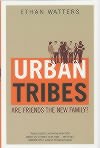 In his intriguing new book Urban Tribes, Californian journalist Ethan Watters argues that, in fact, young adults are forming their own significant communities in place of traditional family units; and finding in these groups some of the benefits that family life offers. Watters claims he discovered the mass phenomena of the Urban Tribe almost accidentally: having written a brief magazine piece on the idea, he was invited on TV to discuss it. In the following weeks his email inbox was inundated by twenty-somethings from all over the US who felt that he had articulated something very real to their lives. They had found community in all sorts of areas: among college friends, in book clubs, at the gym, or even in groups that just kinda evolved from friends and friends-of-friends. People performed different roles within the tribes in order to enable organization and decision-making, nurturing and entertainment. Some group members were valued even though they contributed very little to the group at all.
Watters is insistent that the sense of belonging and loyalty he and others feel is just as strong as family ties may be. He recounts example of remarkably loving and self-less behaviour, and the experiences of great tenderness, group rituals and generous sharing. As he puts it:
After more than a decade, my sense of living as a single person in a modern American city was that of belonging to an intensely loyal community of people. (p.39)
The social conditions that have lead to this phenomenon centre on the remarkable freedom that young adults in western cities now experience. They are wealthy, with a high disposable income; and may choose voluntary poverty in order to study, travel or follow a dream without to much hardship. They have grown up in the age of contraception and sexual liberty which means that sex does not appear to need the safety-net of marriage. The women of this group are the first "post-feminist" generation, aspiring to have a meaningful career as a priority. Socially acceptable behaviour has become a much broader category. Watters notes that the advice that Xers have received from their baby-boomer parents has been strangely reticent and devoid of any heavy moralising. "Only conservative politicians", he writes,
continued to give lifestyle advice as if it were still in style. It was pretty easy to read this for what it was: political posturing. George W. Bush's advice that we abstain from sex before marriage was an excellent example. Given that many of us were delaying marriage until we were thirty or thirty-five, his just-say-no-to-sex rhetoric read like a blatant pandering to the Christian Right or willful ignorance of social trends or both. Regardless of whether we voted or these conservative politicians, the idea that we would let their advice influence our personal choices was laughable. (p.28)
Watters goes on to make the case that separating sex from the decision to marry and delaying that choice leads to much more mature decisions. Gen-Xers, as the first generation who were children of divorced parents, are understandably slow to commit themselves given the domestic disasters they have witnessed.
What Watters describes I found resonated with what I see my contemporaries experiencing in Sydney, where very similar social conditions apply. It strikes me that many evening church congregations or university-based churches resemble urban tribes, in a way which would have been unimaginable only a generation ago. The longing for belonging that so many twenty-somethings feel is an opportunity for these communities. However, it may be the informal contact and the spontaneous social gathering that most unites the group as much as the formal meeting.
I feel strongly however that churches also have the opportunity to remind the generations that they are not the only generation. We must resist and transcend the segmenting of our community into demographic sub-groups, which is chiefly driven by marketers and journalists. The cry of generational identity ("we are such-and-such") is also a cry of non-identity ("and we aren't like you old so-and-sos"). The community of Jesus is built around the shared experience of forgiveness and conversion, not the shared experience of being brought up in the 80s.
Then there's the sex thing. The powerful social trend to delay marriage that Watters notes is fairly universal. For the Christian determined to pursue chastity there are two options " marry early, or marry late and remain celibate. Both choices fly in the face of prevailing cultural wisdom; for the young adult with non-Christian parents it will be probably even counter to their easy-going baby-boomer advice. Trust and commitment in matters of the heart are going to be rare qualities indeed.
Michael Jensen lectures in Church History and Theology at Moore Theological College in Sydney.