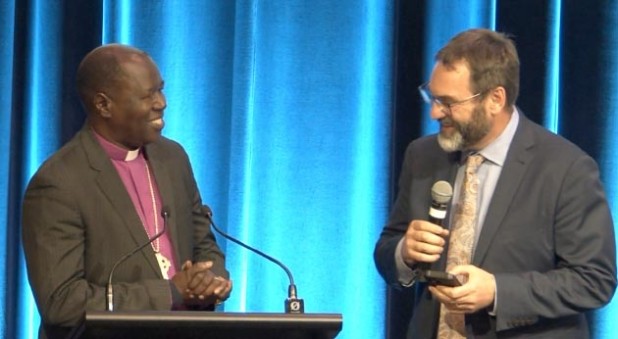
The relationship between Uganda and the Sydney Diocese goes back to 1959, and the first visit by Bishop Festo Kivengere. The strong bonds established then continue to this day. Bishop Alfred Olwa of Lango Diocese, who is also chairman of Uganda Christian University, spoke at Synod to the Rev Dr Simon Gillham.
Simon: Alfred, you studied here in Sydney at Moore College and did your PhD on a giant of the Christian faith, Bishop Festo Kivengere. Could you just tell us more about him?
Alfred: I had the privilege of studying here in Sydney at Moore College, where I completed a PhD on the preaching of Bishop Festo Kivinjeri, especially his doctrine of reconciliation centred in Jesus Christ. Festo was a remarkable leader in Uganda during the years of Idi Amin. He first came to Australia in December 1959, and this was arranged by CMS and Bishop Alfred Stanway. He spoke here in Sydney, he went to the Northern Territory. In fact, the Governor of NSW then decided to ask him if he could be given an appointment as a minister to the Indigenous people because they listened to him very well. But he refused.
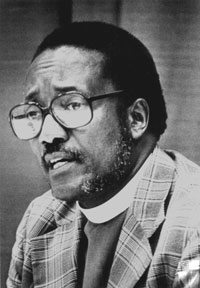
In 1978, he came back, invited by Archbishop Marcus Loane, and he preached in the Cathedral and in many other places, and he was the guest of the Australian Press Club. His famous book, I Love Idi Amin, captured the depths of Christian forgiveness and reconciliation that he preached.
And for me, studying at Moore College on Festo was more than an academic project. It was a way of inheriting a legacy of gospel partnership between Uganda and Sydney. Moore College shaped me truly to think deeply on the gospel. That training is now bearing fruit in Uganda, through ministry, through Uganda Christian University, and through the ongoing mission partnerships that you continue to sustain.
So tonight, let me say this. As we meet in Synod, I want to affirm that what we do together in training, in mission, and in partnership truly strengthens the gospel and the body of Christ.
Simon: That mission partnership that we're talking about between Uganda Christian University involves not just Moore College, but the Archbishop of Sydney's Anglican Aid and CMS. Tell us all a little bit more about that, and particularly the Bishop Tucker School of Theology and Divinity.
Alfred: In 2013, we celebrated 100 years of the Bishop Tucker School of Divinity and Theology, which began in 1913 as the first theological college in East and Southern Africa, stretching as far as Madagascar. And from that start, its vision was simple but profound to raise locally, biblically grounded, theologically trained leaders who could serve the growing church across the continent.
Over the decades, Bishop Tucker has produced pastors, bishops, lay readers, who faithfully carried the gospel through the times of both growth and trial. But when I talk about the establishment of Uganda Christian University, whose vice chancellor is seated here in the Synod tonight, in 1997, the Church of Uganda transformed the Bishop Tucker School of Divinity and Theology, making it into higher education and looking at higher education as a mission field. And the aim was to equip Christian leaders not only for the church, but for every sphere of society.
And today, UCU is the first chartered private university in Uganda, and a leading Christian institution in Africa. We can even argue that it goes beyond in other parts – forming professionals, teachers, doctors, lawyers, business leaders and public servants who integrate their faith into their work.
And the system of training leaders from every diocese, I feel I should come back to this since we are talking about theological education, at the heart of the Bishop Tucker School of Divinity and Theology, training ordinands from every diocese in Uganda. We now have 40 dioceses, and we train across the board.
And the neighboring countries like Tanzania, which is a big area of CMS Australia, then you can go to Rwanda, Burundi, Congo, South Sudan, and truly even to Nigeria, and a few other countries like Egypt, where we have had students trained there.
The alumni of Bishop Tucker, we want to thank God, because it has people like Archbishop Henry Luke Orombi [former Archbishop of Uganda], who is now retired… people like Archbishop Stephen Kaziimba, the current Archbishop. You have the retired Archbishop Kolini of Rwanda. You have the current Primate of South Sudan, Dr Justin Badi, who is the chair for Global South. You can stretch on and on.
The latest, which is really warming my heart, is now Archbishop Abraham Yel Nhial, Archbishop of the Bahr el Ghazal Province in South Sudan, trained at the Bishop Tucker, supported by Anglican Aid.
You need our testimony of God's power to grow the church in hardship. You need our witness of resilience.
Simon: It's very easy to get captured by just how important, how exciting the work of UCU is. Thank you for sharing that with us. But you don't just know Uganda, you know us. What would you like to tell the Synod tonight?
Alfred: Synod, your Archbishop reminded you last year that evangelism is essential because it is the way we love our neighbours as ourselves. At least I caught that online, because my ear is always here. But allow me to add, evangelism is essential because it is the way we love one another across the nations.
We in Africa need you. We need your theological resources – you have some excellent theological resources, both books as well as human resources. We need your training, training capacity. We need you to encourage us in staying faithful in times of persecution and compromise. We need you.
But the other side of the coin – I say this humbly – I believe you also need us here in Sydney. Because you need our testimony of God's power to grow the church in hardship. You need our witness of resilience. We have gone through poverty, through pain, through HIV/AIDS. We've become resilient. You could learn something from that, too. And you need our passion for prayer and praise!
Inset photo: By Korirk01 - Own work, CC BY-SA 4.0