In 2001 Jennie Everist volunteered to help her then pastor, the Rev Dr Glenn Davies, with his counselling overload. Her background was in health, coordinating a program helping people with disabilities to remain independent. Jennie was glad her gifts and skills could be of use to ministry staff. A decade later she is part of that staff team at St Luke's, Miranda, employed four days a week as the parish's pastoral care minister.
The Sutherland Shire parish seems to be bucking a damaging trend within Sydney Anglican churches to "professionalise' ministry. St Luke's is not merely recruiting parishioners like Jennie to be part of the paid staff team. Over the past four years, Miranda has embraced "every member ministry', handing responsibility for key frontline ministry to ordinary parishioners.
 However, few Sydney Anglican churches are heading in the same direction. The latest National Church Life Survey exposes hard evidence that much more effort needs to go into developing a sense of lay ownership of our churches' ministry. Otherwise the result will be a still-born mission and burnt-out clergy.
The percentage of Sydney Anglicans who are strongly committed to their church's vision is declining. In fact more than 40 per cent of Sydney Anglican churchgoers say they know about the vision but feel either cold or lukewarm about it. This figure was 34 per cent in 2001.
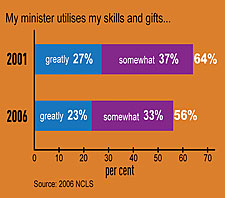
This explains why the NCLS researchers rated "leadership' as one of the Sydney Diocese's weakest points. Leadership is not just about pointing the way forward, but taking people there. While more Sydney Anglicans now say their ministers inspire them to action than in 2001 (72 per cent compared to 68 per cent), the laity feel less like partners in ministry with their pastors and increasingly excluded from decision making. There has been a cdecline in the number of Sydney Anglicans who say their minister encourages them to use their gifts. In 2001, almost two-thirds of Sydney Anglicans said this was the case. Now the figure is just 56 per cent [see chart on right].
At St Luke's, Miranda, "top-down leadership' is a dirty word. The Rev Stephen Gibson, who became rector in 2003, has made Bible study groups responsible for five aspects of ministry: Bible study, prayer, service, pastoral care and most surprisingly " outreach.
 "At first some of the Bible studies were shocked that outreach was part of their responsibility," Mr Gibson said. "But people have come with creative ideas I would never have suggested. The paid staff are now resource people to support the ministry of the congregation."
Outreach activities have included a "grumpy old men's' health workshop, providing a "pamper day' for a secular community group and neighbourhood wine tasting evenings.
Did Mr Gibson fear lay people would not be able to pull off evangelistically appropriate activities?
"We do set the framework for a testimony or gospel message," he says. "But the trouble with top-down initiatives is that people don't respond as well by bringing their friends along. The congregation members don't own it. But if they organise the night then they know their friends will like it."
Mr Gibson has found that a "bottom-up' approach has made ministry at St Luke's more effective, especially at connecting with and integrating newcomers. "I have found you get a higher ratio of outsiders coming if you run lots of smaller events rather than one or two big events organised by the paid staff," he says.
Identifying existing members to take on a paid role, as occurred with Jennie Everist, can also prove beneficial.
"Laypeople have already developed the necessary links with their community," he says, "Jennie has excellent links with Sutherland Hospital that is helping develop the chaplaincy work."