A few months ago Lili Vink's little sister Brie nearly died.
A mystery illness, possibly undiagnosed malaria, had left Brie severely dehydrated.
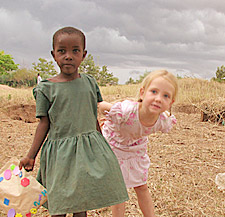
Lili (pictured below) lives with her mum and dad who are CMS missionaries in Musoma, Tanzania, where health services are very poor.
Her dad, Jono, admits the incident was the lowest point for the family this year, but even in this drama they felt God was looking after them.
"It ended up a real answer to prayer," he says. "If she didn't get the drip when she did she would have died."
Concern for our children's well-being is certainly one issue that stops many people from taking the step to the missionfield.
Without sounding trite, however, it does beg the question: have we got our priorities straight?
John Bales, General Secretary of CMS-NSW, says that people would be more prepared for world mission if they really trusted Jesus as Lord.
"If Jesus is really Lord that means I am able to go anywhere. It means I don't need to be scared for my own security, or the health of my children, or the care of my parents because Jesus is Lord."
There are two really significant summer schools happening in the world right now, he says.
"Three million people have been at the Hajj in Mecca and up to 8 million Hindus will be seeking to wash their sins away in the Ganges. There is a world out that beyond Sydney that we have to reach and it won't be reached unless we go."
"There are 2 billion people in the world who will never hear the gospel unless people cross cultures," he says.
"The question that has to be asked is not "Why should I go?' but "Why shouldn't I go?"
This week in our discussion forum we are asking: what is stopping you becoming a missionary
Prioritising limited resources: Sydney or the World?
Prayer and financial support for the Church Missionary Society (CMS) is currently healthy. Only 10 per cent of Sydney Anglican churches don't have a CMS link missionary.
"The level of commitment is very pleasing, but there is an ongoing challenge ahead of us as more people continue to offer for missionary service," says John Bales.
Broader social tends have also seen support for the institution of CMS declining.
"Historically there was huge support from members for the institution of CMS," Mr Bales says. "However, younger people are not as interested in supporting institutions. The focus of their interest in mission is more on a particular missionary."
"Our challenge is to move that into a wider interest in world mission."
Mr Bales agrees that Christians can tend to be navel gazing.
"The difficulty is that people see the issues that are immediately at hand: the need for a youth minister, the need to church plant… that is there right there in front of you."
"Our big challenge is an educational one: we need to be teaching that world mission is integral to the gospel. People need to see that they are part of what God is doing in the world."
However Mr Bales doesn't agree that world mission is in a contest with local mission for limited resources.
It's not Sydney or the world. But Sydney and the world.
Perhaps surprisingly, Mr Bales says the Sydney Diocesan Mission with its focus on converting 10 per cent of Sydney's population has actually had significant positive spin offs for world mission.
"It has stimulated people to think mission and when you think mission you think world mission."
Significant intake
With eight Sydney-trained and Sydney clergy joining CMS this year to be trained as missionaries, this is the largest intake for many years.
"St Andrews Hall is bursting at the seams," says Mr Bales. "Some of our prospective missionaries have been involved in significant church planting initiatives in Sydney and will look to take these skills overseas."
Another issue worth discussing is whether you should be encouraging your rector to leave for o/s?