There’s nothing like a good news story to make your day, and amid all the speeches and decisions at Synod it’s always encouraging to hear what is happening at the grassroots level.
Time is now made during each Synod for one parish in all of the Diocese’s five regions to share a snapshot of local life and ministry. Two of those regions had locations reclassified as full parishes, while the other three – although from very different parts of greater Sydney – had one thing in common: stories that would uplift, inform and result in praise to our heavenly Father.
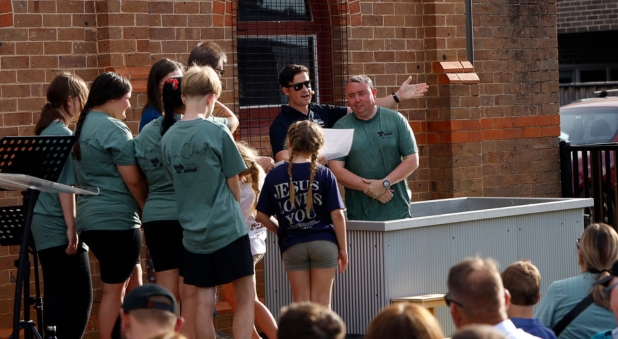
On Synod’s first Tuesday the rector of Picton-Wilton southwest of Sydney, the Rev Ben Boardman, spoke of his parish’s mission to “help people find life in Christ”.
He spoke about its lengthy history (175 years) and the joy of brand-new Christians, as well as the sacrificial generosity of members in funding new ministry and ministry space – particularly for the village of Wilton, which is expected to grow by 70,000 people over the next few decades.
Mr Boardman said that not only had a dozen people come to Christ at Wilton in the past year, but that 18- to 25-year-olds kept walking into the Picton church wanting to learn about Jesus and Christianity.
“All of this planning and building and growth is complicated and messy, yet God is powerfully at work among his people,”
“In 2021, we set out with a five-year plan to grow from being a one-minister church to a two-minister church. [The second minister] focused on youth and young adults and planted a Wilton morning congregation. God’s people have been so generous in response to this challenge that we’ve also been able to employ our first MTS trainee.
“Now it’s time to pray and plan and dream about what God may have in store for our churches over the next few years. Please pray for us, as we plan to establish facilities and people and strategies to help welcome hundreds of people into our churches over the next few years and help them to find life in Christ.”
Shepherded to a new location
The parish of Dundas-Telopea couldn’t be more different. There are no old sandstone churches here – rather, a warehouse complex the parish purchased nine years ago, selling its two 1960s churches in order to create a modern ministry and office space close to Rydalmere residential areas, the ferry wharf and Western Sydney University.
Rector the Rev Canon Alistair Seabrook told Synod members at their Wednesday meeting about the project, “born from an ambitious vision, that has taken much longer than it should have, that has cost far more than originally planned, [and] that many wondered if it would ever be finished!”
In a video with an almost-completed church centre behind him, he spoke of how the area’s population was expected to grow by 30 per cent over the coming 20 years, “so [this location] sets the church up really well to witness to Jesus in the years to come.
“It joins up all the things we’re seeking to do as a church in the local community in one place,”
He explained that the plan of the two-storey ministry centre was unusual “because the auditorium is upstairs, and that’s because we wanted the first view of the building during the week to be where all the activity is.
“I’m hoping that’s going to help us connect people... they come onsite for an activity like Everyday English, they get an opportunity to then maybe come back and join a course where they can learn more about who Jesus is and what it would mean for them to follow him, and then they can be invited into Sunday gatherings with us.”
Canon Seabrook said when the foundation stone of one of their old churches was removed, a letter was found written by its first rector, who spoke of the congregation being “known for the warmth of its Christian love”, and that “the aim of its varied ministry is the winning of men and women, boys and girls, to Christ, the building up of believers in their faith, and the lifting up and glorifying of the Lord Jesus Christ”.
Said Canon Seabrook: “I love that, because that’s the church that I lead... that’s still the character of the church today. I feel so privileged to be their pastor and to have led them through this.”
The parish plans to hold the first service in its new location on November 30, when it will also officially change its name to Shepherd’s Wharf Anglican Church.
Prayerful and missional
On Synod’s final day, members were given a glimpse into God’s work in the upper North Shore parish of Wahroonga, with rector the Rev Andrew Rees giving thanks for gospel fruit among the people of his suburb.
He said that when he arrived at St Andrew’s, Wahroonga in late 2014, he was struck by the many gospel opportunities. He also found “a prayerful church family who were well taught and up for mission. As we’ve served in this mission, the gospel has grown our church”.
From 2014 to 2021, adult numbers grew fourfold, while the proportion of children and youth expanded even more.
In 2021, a partnership began with St Paul’s, Wahroonga, which led to the two parishes amalgamating the following year. This step was taken only after months of conversation, prayer and a conscious decision to “stop trying to get things back to the way they were pre-COVID – we were doing something new together”.
Members of another congregation in Warrawee that closed also became part of the parish, so there have been many changes to navigate.
However, Mr Rees said, members “spent time forming a shared new language and identity. St Paul’s became Pearce’s Corner; St Andrew’s became Water Street. We reset everything... all our congregations had new times, locations and leadership, including planting an all-age congregation at Pearce’s Corner.
“This congregation was the epicentre of our three-church cultural mix, with everyone feeling the pinch of change.
“We spent time reframing it. This was not a ‘franchise’ of St Andrew’s – this was a church plant on mission. We invested heavily in the site to remove physical obstacles to mission, and it has grown to become our most mission-minded, united congregation!”
Mr Rees said the parish is praising God for continued growth, increasing cultural diversity and a desire to contribute to the spreading of the gospel beyond its borders. Yet, he added, “the parts of God’s mission that we have come to delight in most are the stories of those who have come home to their heavenly Father”.
These include an older woman who returned to church and joy in Jesus for the first time in 50 years because someone from the parish knocked on her door and invited her; members of a parish ESL class, from a gospel-poor nation, who are now brothers and sisters in the Lord; and neighbours who came to church one day, never expecting to find Jesus – but they did.
“Wahroonga is an Indigenous word that means ‘our home’,” Mr Rees said. “It’s home to thousands, who, when it comes to the gospel of the Lord Jesus, cannot tell their right hand from their left. And yet, in Wahroonga, this gospel is bearing fruit and multiplying.”