When you see provisions for people with disability at your church, do you ever put yourself in the shoes of the person who will use them? Or do you just assume that the hearing loop has a practical set-up for visitors, the news sheets and overheads can be read by everyone, and no-stairs access into the church means that those with physical impairments can get around easily?
Chances are that even if everything looks fine, you’re going to miss something.
Not because you’re thoughtless, but because you don’t have a lived experience of disability.
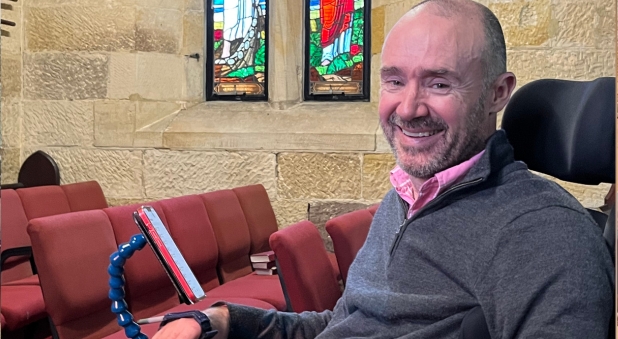
David Deitz admits that this “totally” used to be him. He has been a quadriplegic since a bicycle accident in early 2023 and says that, beforehand, “I was oblivious to many of the things that are now blatantly obvious”.
He’s not angry that people don’t understand or consider the difficulties he and others face at church, because this was once his own headspace. He does, however, want to help churchgoers see their parish’s accessibility provisions with new eyes, and help to address issues that can prevent people with disability being fully involved in church services and fellowship.
Mr Deitz takes me inside St Michael’s Cathedral in Wollongong – his family’s church for the past 12 years. Next to a pew near the back of the heritage-listed building, a disabled sign is painted on the carpet, in a place where he and his chair can slot right in.
Now, your average able-bodied person would see that, be happy that the church has remembered the needs of people with physical disabilities and think no more about it. For Mr Deitz, however, it is one of only two places in the entire church where he can park his wheelchair.
On a Sunday, it’s difficult for him to catch up with particular people if they’re already seated in a pew or there are lots of people milling about. Once the service begins, when everyone else stands up to sing, he can’t see the overhead. He has to be in the other space where his chair fits to see the words, unless someone else in a wheelchair (or a parent with a pram) is already there.
Mr Deitz has also noticed that, since the accident, people respond to him differently. “Having such a visible disability, I’ve experienced people’s awkwardness around that – not knowing what to say or how to approach me – and that’s been an eye opener,” he says.
“If I’m sitting up the back in my spot, often I’ll wait for everyone to leave the church, and I’ll make eye contact and say ‘Hello’ as they go past, and some people just won’t talk to me... I can see them look away or avoid.
“The chair shows people that you have a disability, but often people with hidden disability are assumed to not have disability and they experience the other side of it.”
Mr Deitz returned to his job as a high school principal earlier this year after modifications were made to the buildings to ensure he has independent access to wherever he needs to go. He wants to encourage parishes and congregations to think more carefully about how they, too, can create a more level playing field for those with disability – whether it’s for someone already in their midst, or a person who is coming to church for the first time.
He offers a few examples for people to consider from his own situation:
- remember not to stand in closed circles when chatting. This sends the clear message that no one else is welcome in the group and it will put off any newcomer
- where possible, provide flexible seating so those with physical disability have the same seating choices as everyone else
- make it easier for those with disability to serve (for example, a small ramp over two stone steps at St Michael’s would allow Mr Deitz access to the microphone, giving him the opportunity to do Bible reading or prayer. Those with disability could also be on a congregation’s welcoming team
- try and ensure morning tea or supper is in a location with easy access for all, eg. a place with stairs or grassed areas immediately impairs access for those with physical disability
- provide opportunities during service time for a range of people – mothers with kids, singles, youth, the elderly, and those with disability – to talk about what church is like for them
- use inclusive language, for example, “We’re going to sing now, so please stand if you’re able”. This doesn’t just encompass those in wheelchairs! An elderly person who is unsteady on their feet, someone with a broken leg, or even a parent sitting with a sleeping baby, will feel seen and understood if they can’t stand up.
“I think we can do more to normalise it [disability],” Mr Deitz says. “We can have people with disability talk to their congregations about what it’s like – what’s their experience and what makes it better for them in church – as part of a program the parish may have around getting to know people, knowing what helps them and what they find difficult when they come to church. Just having that honest conversation.
“It’s all about looking at the spaces and finding ways to allow people with disability and those without to interact and engage on an equal basis.”