by MARGARET RODGERS
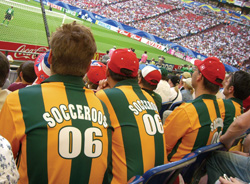
World Cup fever has gripped the globe over the past few weeks. Football has been dominant in all media. Even Southern Cross devoted considerable space in its June edition to the World Cup and Christian sports people.
Few people here in Australia seemed to notice a global discussion accompanying the football news. It never made the sports pages in Australia " Les Murray made no comment - but on the internet, and in other parts of the world the issue of prostitution and the World Cup has received major attention.
Host country Germany, coming out of an economic recession, has worked hard to provide every facility for the entertainment of football fans. Stadiums have been built or refurbished and giant screens are everywhere for fans without tickets to watch matches.
But since Germany legalised prostitution in 2002, other facilities are provided for the seamier side of the celebrations. There is a huge four-storey brothel in Berlin, a short bus ride from the Stadium. It has room for 100 prostitutes and boasts it can cater for 650 men a day.
In Cologne an area the size of a football field has been fenced off on the outskirts of the city, and it caters for drive-in prostitution. Small huts known as "performance boxes' are equipped with condom-vending machines, showers and alarms. Other cities are providing mobile brothels.
There has been an outcry throughout Europe from countries who do not share Germany's liberal approach to prostitution. For example, the Council of Europe, the Nordic Council and Amnesty International have spoken out. And, to be fair, there has been internal opposition. The National Council of German Women's Organisations has led a Red Card for Forced Prostitution Campaign.
On the whole their protests have centred on forced prostitution and the trafficking of women from Eastern Europe, in particular, to service the sex industry in Germany. Reports suggest some 40,000 women will have come to Germany to fulfil the demands of the World Cup trade.
But some voices have spoken against prostitution generally. Archbishop Agostino Marchetto said on Vatican Radio:
"Prostitution, in fact, violates the dignity of the human person, making the latter an object and instrument of sexual pleasure. Women become merchandise that can be purchased, whose cost is even lower than a ticket to a soccer match".
The French coach, Raymond Domenech has made his views public, though he is almost a lone voice in the football hierarchy.
"It is truly scandalous. People are talking about women, importing them to satisfy the base instincts of people associated with football," he said. "It is humiliating enough for me that football is linked with alcohol and violence. Human beings are being talked about like cattle and football is linked with that."
Raymond Domenech points to a reality that should concern all fans and observers. He links his sport to alcohol, violence and the sex trade.
In our country we should not simply condemn the Germans for their liberal attitude to prostitution. We could only do so if we were certain that there is no similar link in the sporting codes of our own nation.
But the occasional stories that appear in the Australian media indicate we do have similar problems, no matter how much they are hushed up by officials and friendly media.
The NRL and the AFL are now holding workshops to assist their players to avoid the dangers of increased alcohol consumption and violence on and off the field. They are also advising them on how to resist the dangers that come from the adulation of the "groupies' or "footy chicks', who surround them after matches.
Those who invite Christian sportspeople to speak at parish evangelistic events should ask them to speak publicly about the temptations facing them, so they don't just glamorise sport, but tell it as it is. Then, in Christian fellowship they can alert young people to the existence of sport's dark side, and not just brush it under the carpet.